
Ch.4 - Chemical Quantities & Aqueous Reactions
Tro - Chemistry: A Molecular Approach 4th Edition
Tro4th EditionChemistry: A Molecular ApproachISBN: 9780134112831당신이 사용하는 게 아니라요?교과서 변경
4장, 문제 49

Lead ions can be precipitated from solution with KCl according to the reaction: Pb2+ (aq) + 2 KCl(aq) → PbCl2(s) + 2 K+ (aq). When 28.5 g KCl is added to a solution containing 25.7 g Pb2+, a PbCl2 precipitate forms. The precipitate is filtered, dried, and found to have a mass of 29.4 g. Determine the percent yield for the reaction. Determine the theoretical yield of PbCl2. Determine the limiting reactant.

검증된 단계별 안내
1
Step 1: Calculate the moles of KCl and Pb^{2+}.
Step 2: Use the balanced chemical equation to determine the stoichiometric ratio and identify the limiting reactant.
Step 3: Calculate the theoretical yield of PbCl_2 based on the limiting reactant.
Step 4: Use the actual yield of PbCl_2 to calculate the percent yield.
Step 5: Summarize the findings: theoretical yield, limiting reactant, and percent yield.

주요 개념

질문에 올바르게 답하기 위해 반드시 이해해야 하는 핵심 개념들은 다음과 같습니다.

Stoichiometry

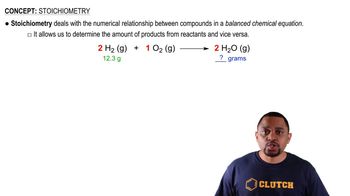
Stoichiometry is the calculation of reactants and products in chemical reactions based on the balanced chemical equation. It allows us to determine the relationships between the quantities of substances involved in a reaction. In this case, stoichiometry will help identify how much PbCl2 can theoretically be produced from the given amounts of Pb2+ and KCl.
추천 영상:
가이드 코스
01:16
Stoichiometry Concept

Limiting Reactant

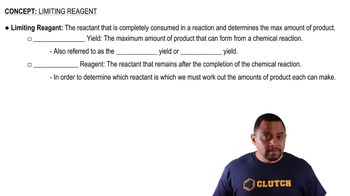
The limiting reactant is the substance that is completely consumed first in a chemical reaction, thus determining the maximum amount of product that can be formed. To find the limiting reactant, one must compare the mole ratios of the reactants based on the balanced equation. In this scenario, identifying the limiting reactant is crucial for calculating the theoretical yield of PbCl2.
추천 영상:
가이드 코스
01:30
Limiting Reagent Concept

Percent Yield

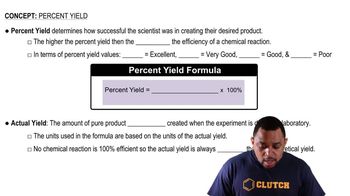
Percent yield is a measure of the efficiency of a chemical reaction, calculated by comparing the actual yield of a product to its theoretical yield. It is expressed as a percentage and provides insight into how much of the expected product was actually obtained. In this problem, calculating the percent yield will involve using the mass of the dried PbCl2 precipitate and the theoretical yield derived from stoichiometric calculations.
추천 영상:
가이드 코스
03:09
Percent Yield in Reactions
관련 실천
교과서 질문

Elemental phosphorus reacts with chlorine gas according to the equation: P4(s) + 6 Cl2( g) → 4 PCl3(l) A reaction mixture initially contains 45.69 g P4 and 131.3 g Cl2. Once the reaction has occurred as completely as possible, what mass (in g) of the excess reactant remains?

3657
views
1
rank
교과서 질문

Iron(III) oxide reacts with carbon monoxide according to the equation: Fe2O3(s) + 3 CO(g) → 2 Fe(s) + 3 CO2(g) A reaction mixture initially contains 22.55 g Fe2O3 and 14.78 g CO. Once the reaction has occurred as completely as possible, what mass (in g) of the excess reactant remains?

16942
views
교과서 질문

For the reaction shown, calculate the theoretical yield of the product (in grams) for each initial amount of reactants. Ti(s) + 2 F2( g) → TiF4(s) c. 0.233 g Ti, 0.288 g F2

3446
views
1
rank
교과서 질문

Urea (CH4N2O) is a common fertilizer that is synthesized by the reaction of ammonia (NH3) with carbon dioxide: 2 NH3(aq) + CO2(aq) → CH4N2O(aq) + H2O(l) In an industrial synthesis of urea, a chemist combines 136.4 kg of ammonia with 211.4 kg of carbon dioxide and obtains 168.4 kg of urea. Determine the limiting reactant, theoretical yield of urea, and percent yield for the reaction.

8570
views
1
comments
교과서 질문

Magnesium oxide can be made by heating magnesium metal in the presence of oxygen. The balanced equation for the reaction is: 2 Mg(s) + O2(g) → 2 MgO(s) When 10.1 g of Mg reacts with 10.5 g O2, 11.9 g MgO is collected. Determine the limiting reactant, theoretical yield, and percent yield for the reaction.

10217
views