Ch.4 - Chemical Quantities & Aqueous Reactions
Tro - Chemistry: A Molecular Approach 4th Edition
Tro4th EditionChemistry: A Molecular ApproachISBN: 9780134112831당신이 사용하는 게 아니라요?교과서 변경
4장, 문제 77c

Write a molecular equation for the precipitation reaction that occurs (if any) when each pair of aqueous solutions is mixed. If no reaction occurs, write 'NO REACTION.' c. copper(II) nitrate and magnesium sulfide

검증된 단계별 안내
1
Identify the ions present in each compound: Copper(II) nitrate (Cu(NO_3)_2) dissociates into Cu^{2+} and NO_3^- ions, while magnesium sulfide (MgS) dissociates into Mg^{2+} and S^{2-} ions.
Determine the possible products by swapping the ions: The potential products are copper(II) sulfide (CuS) and magnesium nitrate (Mg(NO_3)_2).
Check the solubility of the potential products: Refer to solubility rules to determine if any of the products are insoluble. Copper(II) sulfide (CuS) is insoluble in water, while magnesium nitrate (Mg(NO_3)_2) is soluble.
Write the balanced molecular equation for the reaction: Cu(NO_3)_2(aq) + MgS(aq) \(\rightarrow\) CuS(s) + Mg(NO_3)_2(aq).
Conclude that a precipitation reaction occurs because CuS is an insoluble solid that precipitates out of the solution.

비슷한 문제에 대한 검증된 영상 답변:

이 영상 해법은 위 문제에 도움이 된다고 튜터들이 추천한 것입니다.
영상 길이:
1m
도움이 되었나요?

주요 개념

질문에 올바르게 답하기 위해 반드시 이해해야 하는 핵심 개념들은 다음과 같습니다.

Precipitation Reactions

Precipitation reactions occur when two aqueous solutions react to form an insoluble solid, known as a precipitate. This process typically involves the exchange of ions between the reactants, leading to the formation of a compound that is not soluble in water. Identifying whether a precipitate forms requires knowledge of solubility rules, which dictate the solubility of various ionic compounds in water.
추천 영상:
가이드 코스
01:53
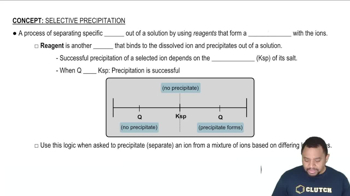
Selective Precipitation

Molecular Equations

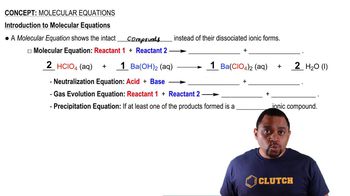
A molecular equation represents the reactants and products of a chemical reaction in their molecular forms, without showing the dissociation of ions in solution. In the context of precipitation reactions, the molecular equation provides a clear depiction of the substances involved before and after the reaction, allowing for easier identification of the precipitate formed, if any.
추천 영상:
가이드 코스
02:24
Types of Molecular Equations

Solubility Rules

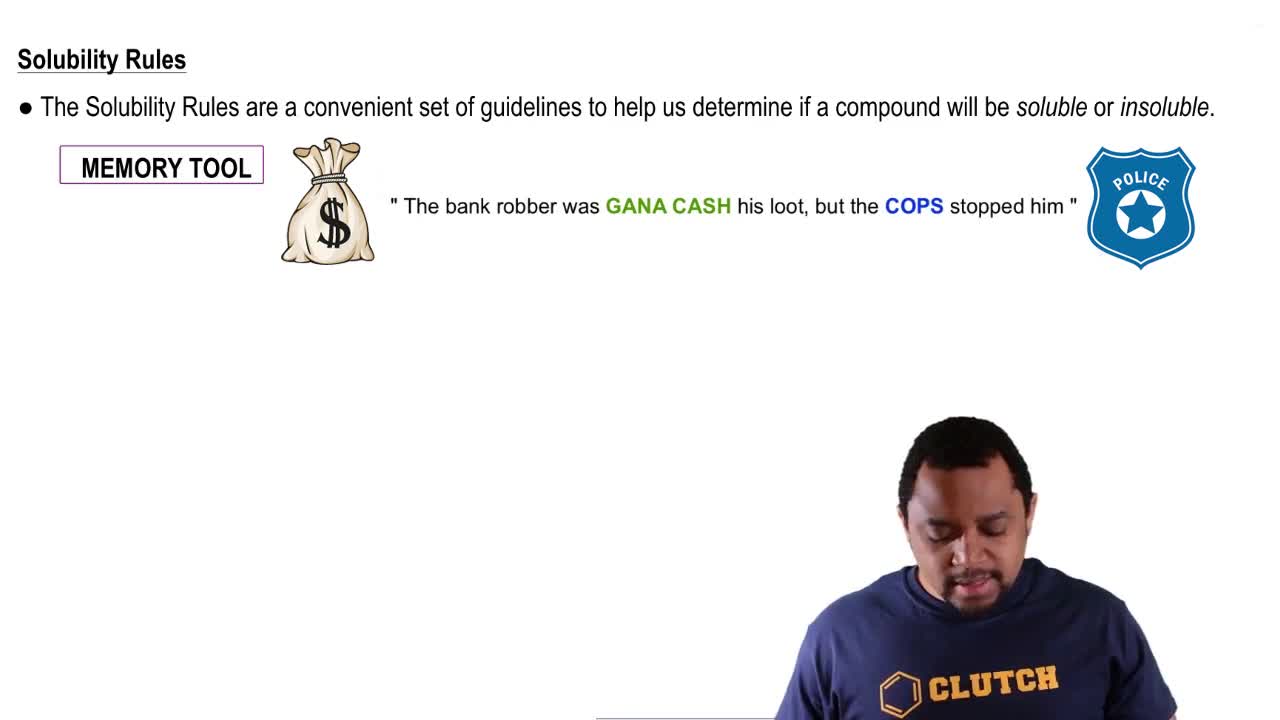
Solubility rules are guidelines that help predict whether a particular ionic compound will dissolve in water. These rules indicate which combinations of cations and anions will result in soluble or insoluble products. For example, most sulfides are insoluble except for those of alkali metals and alkaline earth metals, which is crucial for determining the outcome of the reaction between copper(II) nitrate and magnesium sulfide.
추천 영상:
가이드 코스
00:28
Solubility Rules