A cylinder with a moveable piston contains 0.553 mol of gas and has a volume of 253 mL. What is its volume if an additional 0.365 mol of gas is added to the cylinder? (Assume constant temperature and pressure.)
Ch.5 - Gases
5장, 문제 34
A syringe containing 1.55 mL of oxygen gas is cooled from 95.3 °C to 0.0 °C. What is the final volume of oxygen gas?
검증된 단계별 안내1
Identify the initial and final temperatures: \( T_1 = 95.3 \, ^\circ\text{C} \) and \( T_2 = 0.0 \, ^\circ\text{C} \). Convert these temperatures to Kelvin by adding 273.15 to each.
Use Charles's Law, which states that \( \frac{V_1}{T_1} = \frac{V_2}{T_2} \), where \( V_1 \) and \( V_2 \) are the initial and final volumes, and \( T_1 \) and \( T_2 \) are the initial and final temperatures in Kelvin.
Substitute the known values into Charles's Law: \( V_1 = 1.55 \, \text{mL} \), \( T_1 = 95.3 + 273.15 \, \text{K} \), and \( T_2 = 0.0 + 273.15 \, \text{K} \).
Rearrange the equation to solve for \( V_2 \): \( V_2 = V_1 \times \frac{T_2}{T_1} \).
Calculate \( V_2 \) using the rearranged equation to find the final volume of the oxygen gas.

비슷한 문제에 대한 검증된 영상 답변:
이 영상 해법은 위 문제에 도움이 된다고 튜터들이 추천한 것입니다.
주요 개념
질문에 올바르게 답하기 위해 반드시 이해해야 하는 핵심 개념들은 다음과 같습니다.
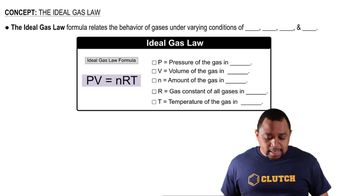
Ideal Gas Law
The Ideal Gas Law relates the pressure, volume, temperature, and number of moles of a gas through the equation PV = nRT. This law assumes that gases behave ideally, meaning they occupy no volume and have no intermolecular forces. Understanding this relationship is crucial for solving problems involving gas behavior under changing conditions.
추천 영상:
가이드 코스
Ideal Gas Law Formula
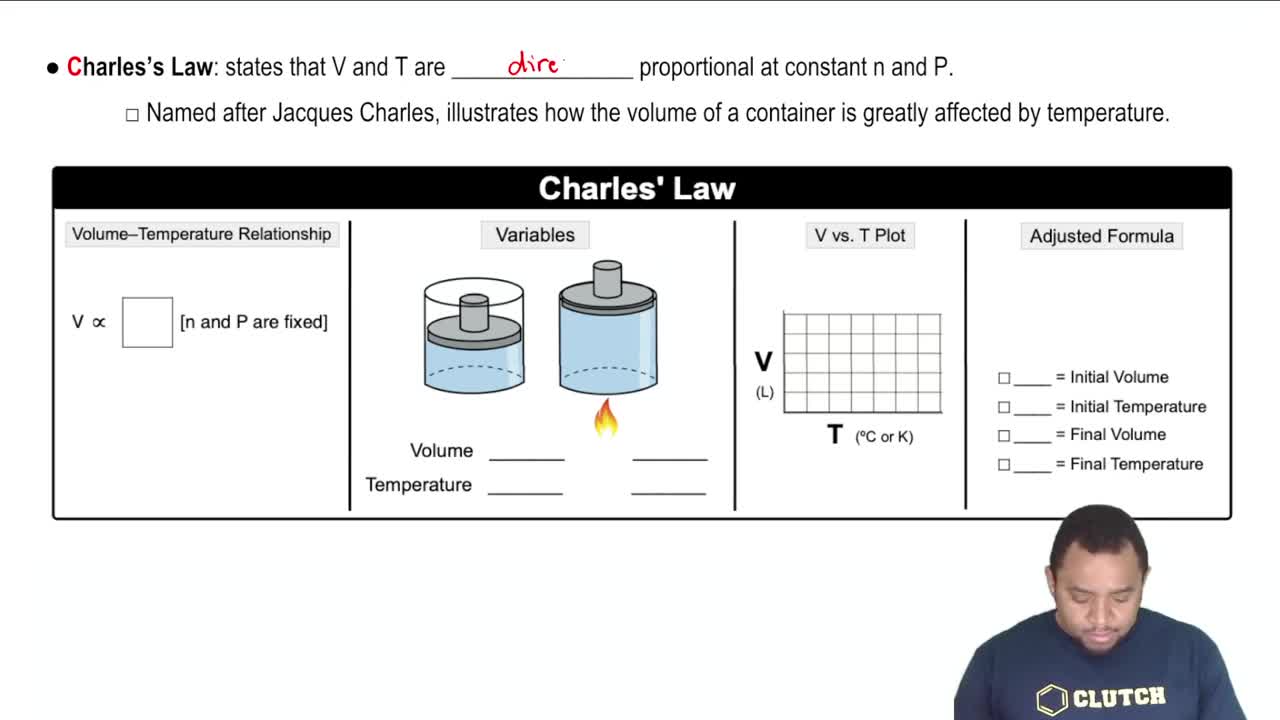
Charles's Law
Charles's Law states that the volume of a gas is directly proportional to its temperature (in Kelvin) when pressure is held constant. This means that as the temperature of a gas decreases, its volume also decreases. This principle is essential for calculating the final volume of gas when the temperature changes, as in the given question.
추천 영상:
가이드 코스
Charles's Law
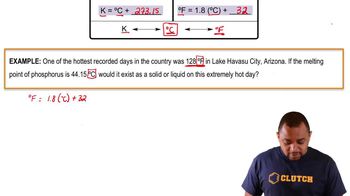
Temperature Conversion
In gas law calculations, temperatures must be expressed in Kelvin rather than Celsius. The conversion from Celsius to Kelvin is done by adding 273.15 to the Celsius temperature. This conversion is necessary to ensure accurate calculations when applying gas laws, as they require absolute temperature values.
추천 영상:
가이드 코스
Temperature Conversion Example
관련 실천
교과서 질문
3156
views
교과서 질문
A balloon contains 0.158 mol of gas and has a volume of 2.46 L. If an additional 0.113 mol of gas is added to the balloon (at the same temperature and pressure), what is its final volume?
3618
views
1
rank
교과서 질문
A sample of gas has an initial volume of 5.6 L at a pressure of 735 mmHg. If the volume of the gas is increased to 9.4 L, what is its pressure?
1878
views
교과서 질문
What volume is occupied by 0.118 mol of helium gas at a pressure of 0.97 atm and a temperature of 305 K?
817
views
교과서 질문
A 48.3-mL sample of gas in a cylinder is warmed from 22 °C to 87 °C. What is its volume at the final temperature?
2726
views
1
rank
1
comments
교과서 질문
A sample of gas has an initial volume of 13.9 L at a pressure of 1.22 atm. If the sample is compressed to a volume of 10.3 L, what is its pressure?
2842
views