Ch.5 - Gases
Tro - Chemistry: A Molecular Approach 4th Edition
Tro4th EditionChemistry: A Molecular ApproachISBN: 9780134112831당신이 사용하는 게 아니라요?교과서 변경
5장, 문제 83a

Calculate the root mean square velocity of F2, Cl2, and Br2 at 298 K.

검증된 단계별 안내
1
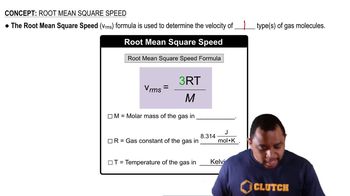
Identify the formula for root mean square velocity: \(v_{rms} = \sqrt{\frac{3RT}{M}}\), where \(R\) is the ideal gas constant, \(T\) is the temperature in Kelvin, and \(M\) is the molar mass in kg/mol.
Convert the molar masses of F\(_2\), Cl\(_2\), and Br\(_2\) from g/mol to kg/mol. For example, F\(_2\) has a molar mass of approximately 38 g/mol, which is 0.038 kg/mol.
Use the ideal gas constant \(R = 8.314 \text{ J/(mol K)}\) and the given temperature \(T = 298 \text{ K}\) in the formula.
Substitute the values for \(R\), \(T\), and the molar mass \(M\) for each gas into the root mean square velocity formula.
Calculate the root mean square velocity for each gas using the substituted values.

비슷한 문제에 대한 검증된 영상 답변:

이 영상 해법은 위 문제에 도움이 된다고 튜터들이 추천한 것입니다.
영상 길이:
5m

주요 개념

질문에 올바르게 답하기 위해 반드시 이해해야 하는 핵심 개념들은 다음과 같습니다.

Root Mean Square Velocity (rms velocity)

Root mean square velocity is a measure of the average speed of particles in a gas. It is calculated using the formula v_rms = sqrt(3RT/M), where R is the ideal gas constant, T is the temperature in Kelvin, and M is the molar mass of the gas in kg/mol. This concept is crucial for understanding the kinetic theory of gases, which relates temperature to molecular motion.
추천 영상:
가이드 코스
01:05
Root Mean Square Speed Formula

Molar Mass

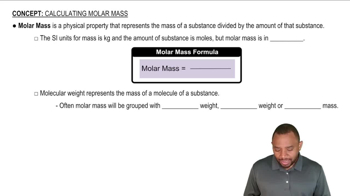
Molar mass is the mass of one mole of a substance, typically expressed in grams per mole (g/mol). For diatomic molecules like F2, Cl2, and Br2, the molar mass is calculated by summing the atomic masses of the constituent atoms. Knowing the molar mass is essential for calculating the rms velocity, as it directly influences the speed of gas particles at a given temperature.
추천 영상:
가이드 코스
02:11
Molar Mass Concept

Kinetic Theory of Gases

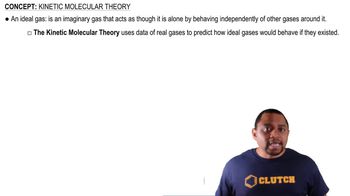
The kinetic theory of gases describes the behavior of gases in terms of particles in constant motion. It explains how temperature, pressure, and volume relate to the motion and energy of gas molecules. This theory underpins the derivation of the rms velocity formula and helps predict how different gases will behave under similar conditions, such as temperature.
추천 영상:
가이드 코스
01:19
Kinetic Molecular Theory