Ch.5 - Gases
Tro - Chemistry: A Molecular Approach 4th Edition
Tro4th EditionChemistry: A Molecular ApproachISBN: 9780134112831당신이 사용하는 게 아니라요?교과서 변경
5장, 문제 30a

Given a barometric pressure of 751.5 mmHg, calculate the pressure of each gas sample as indicated by the manometer.
(a)

검증된 단계별 안내
1
Identify the type of manometer used (open or closed) to determine how to relate the manometer reading to the barometric pressure.
If it's an open manometer, determine whether the gas pressure is greater or less than the atmospheric pressure by observing the height difference in the manometer.
For an open manometer, if the gas pressure is greater than atmospheric pressure, add the height difference to the barometric pressure. If less, subtract the height difference from the barometric pressure.
If it's a closed manometer, the gas pressure is equal to the height difference since there is no atmospheric pressure to consider.
Use the appropriate formula based on the type of manometer to calculate the gas pressure. For open: \( P_{gas} = P_{atm} \pm h \), and for closed: \( P_{gas} = h \).

비슷한 문제에 대한 검증된 영상 답변:

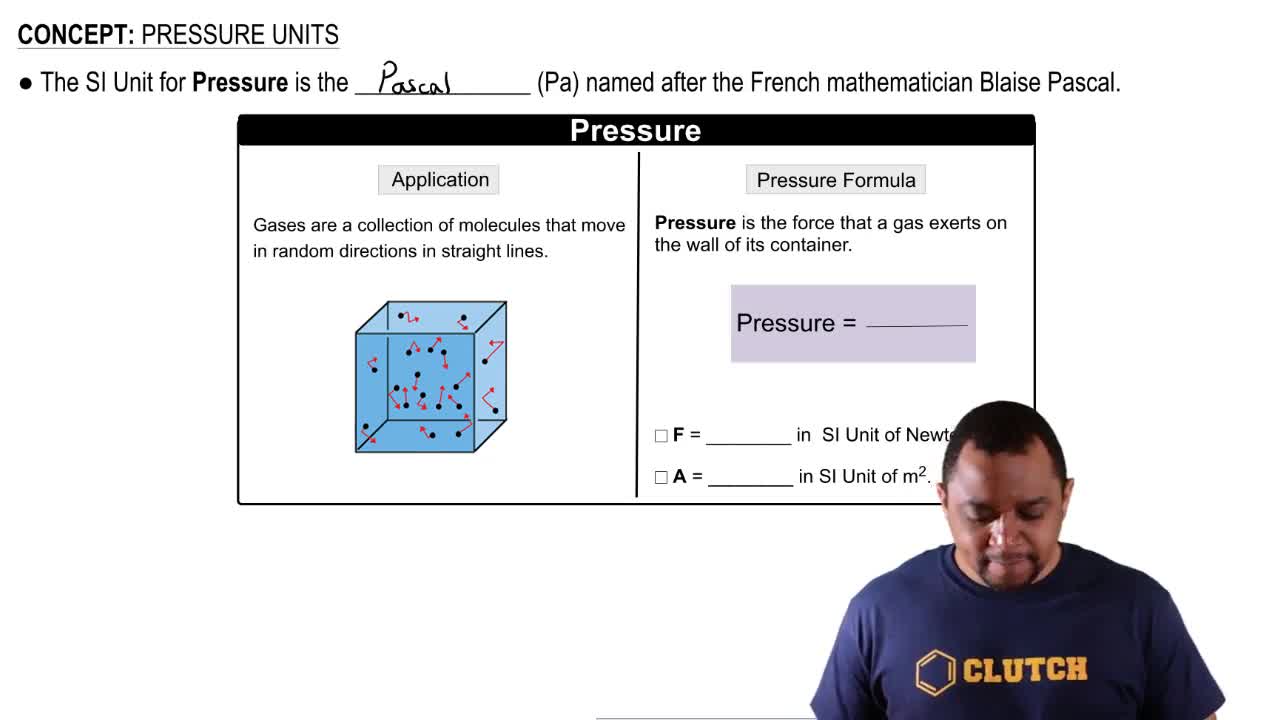
이 영상 해법은 위 문제에 도움이 된다고 튜터들이 추천한 것입니다.
영상 길이:
4m

주요 개념

질문에 올바르게 답하기 위해 반드시 이해해야 하는 핵심 개념들은 다음과 같습니다.

Barometric Pressure

Barometric pressure is the pressure exerted by the weight of the atmosphere at a given point. It is commonly measured in millimeters of mercury (mmHg) and is crucial for understanding how gases behave under different atmospheric conditions. In this context, the barometric pressure of 751.5 mmHg serves as a reference point for calculating the pressure of gas samples in a manometer.
추천 영상:

Manometer

A manometer is a device used to measure the pressure of gases. It typically consists of a U-shaped tube filled with liquid, often mercury, where the difference in liquid height between the two arms indicates the pressure of the gas relative to atmospheric pressure. Understanding how to read a manometer is essential for determining the pressure of gas samples accurately.

Gas Laws

Gas laws describe the relationships between pressure, volume, temperature, and the number of moles of a gas. Key laws include Boyle's Law, which states that pressure and volume are inversely related at constant temperature, and Dalton's Law of Partial Pressures, which states that the total pressure of a gas mixture is the sum of the partial pressures of its individual gases. These principles are vital for calculating the pressures of gas samples in relation to the given barometric pressure.
추천 영상:
가이드 코스
01:43
Combined Gas Law