Ch.5 - Gases
Tro - Chemistry: A Molecular Approach 4th Edition
Tro4th EditionChemistry: A Molecular ApproachISBN: 9780134112831당신이 사용하는 게 아니라요?교과서 변경
5장, 문제 89

The graph shows the distribution of molecular velocities for two different molecules (A and B) at the same temperature. Which molecule has the higher molar mass? Which molecule has the higher rate of effusion?
Graph showing molecular velocity distributions for two molecules at the same temperature.

검증된 단계별 안내
1
Identify the two curves on the graph. The curve with the peak at a lower velocity represents molecule A, and the curve with the peak at a higher velocity represents molecule B.
Recall that at the same temperature, lighter molecules move faster than heavier molecules. Therefore, the molecule with the higher peak velocity (molecule B) has a lower molar mass.
Conversely, the molecule with the lower peak velocity (molecule A) has a higher molar mass.
According to Graham's law of effusion, the rate of effusion of a gas is inversely proportional to the square root of its molar mass. Therefore, the molecule with the lower molar mass (molecule B) will have a higher rate of effusion.
Summarize the findings: Molecule A has the higher molar mass, and molecule B has the higher rate of effusion.

비슷한 문제에 대한 검증된 영상 답변:

이 영상 해법은 위 문제에 도움이 된다고 튜터들이 추천한 것입니다.
영상 길이:
5m
도움이 되었나요?

주요 개념

질문에 올바르게 답하기 위해 반드시 이해해야 하는 핵심 개념들은 다음과 같습니다.

Molecular Velocity Distribution

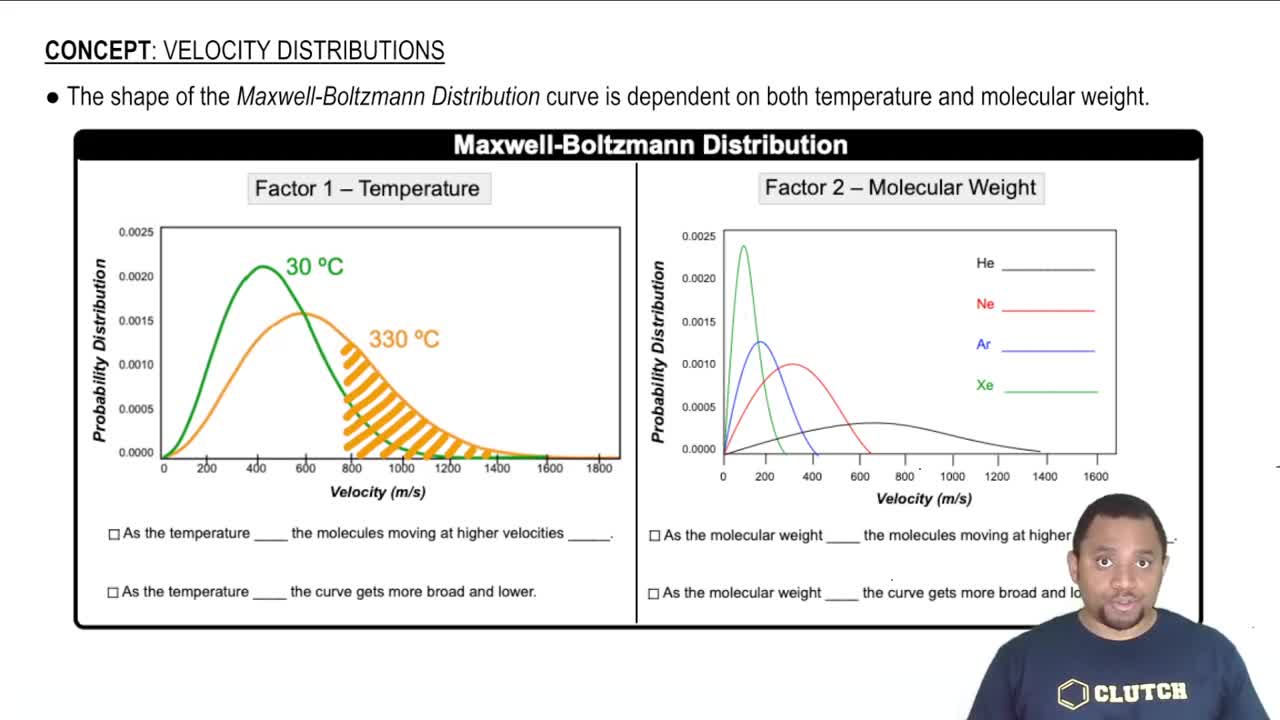
The molecular velocity distribution describes how the speeds of molecules in a gas vary at a given temperature. It is typically represented by a graph showing the number of molecules at different velocities. The shape of the distribution indicates the average speed and the spread of molecular speeds, which is influenced by the mass of the molecules.
추천 영상:
가이드 코스
02:47
Velocity Distributions

Graham's Law of Effusion

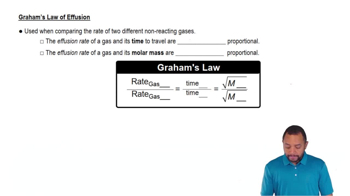
Graham's Law states that the rate of effusion of a gas is inversely proportional to the square root of its molar mass. This means that lighter molecules effuse faster than heavier ones. In the context of the question, the molecule with the higher average velocity in the distribution graph will have a lower molar mass and thus a higher rate of effusion.
추천 영상:
가이드 코스
2:03
Graham's Law of Effusion

Kinetic Molecular Theory

Kinetic Molecular Theory explains the behavior of gases in terms of particle motion. It posits that gas molecules are in constant random motion and that temperature is a measure of the average kinetic energy of these molecules. This theory helps to understand why lighter molecules move faster than heavier ones at the same temperature, affecting their velocity distribution and effusion rates.
추천 영상:
가이드 코스
01:19
Kinetic Molecular Theory