Ch.5 - Gases
Tro - Chemistry: A Molecular Approach 4th Edition
Tro4th EditionChemistry: A Molecular ApproachISBN: 9780134112831당신이 사용하는 게 아니라요?교과서 변경
5장, 문제 25b

The pressure in Denver, Colorado (elevation 5280 ft), averages about 24.9 in Hg. Convert this pressure to each indicated unit. b. mmHg

검증된 단계별 안내
1
Identify the given pressure in inches of mercury (in Hg), which is 24.9 in Hg.
Recall the conversion factor between inches of mercury and millimeters of mercury: 1 in Hg = 25.4 mmHg.
Set up the conversion by multiplying the given pressure in inches of mercury by the conversion factor: 24.9 in Hg * 25.4 mmHg/in Hg.
Perform the multiplication to convert the pressure from inches of mercury to millimeters of mercury.
The result will give you the pressure in mmHg.

비슷한 문제에 대한 검증된 영상 답변:

이 영상 해법은 위 문제에 도움이 된다고 튜터들이 추천한 것입니다.
영상 길이:
34s

주요 개념

질문에 올바르게 답하기 위해 반드시 이해해야 하는 핵심 개념들은 다음과 같습니다.

Pressure Units

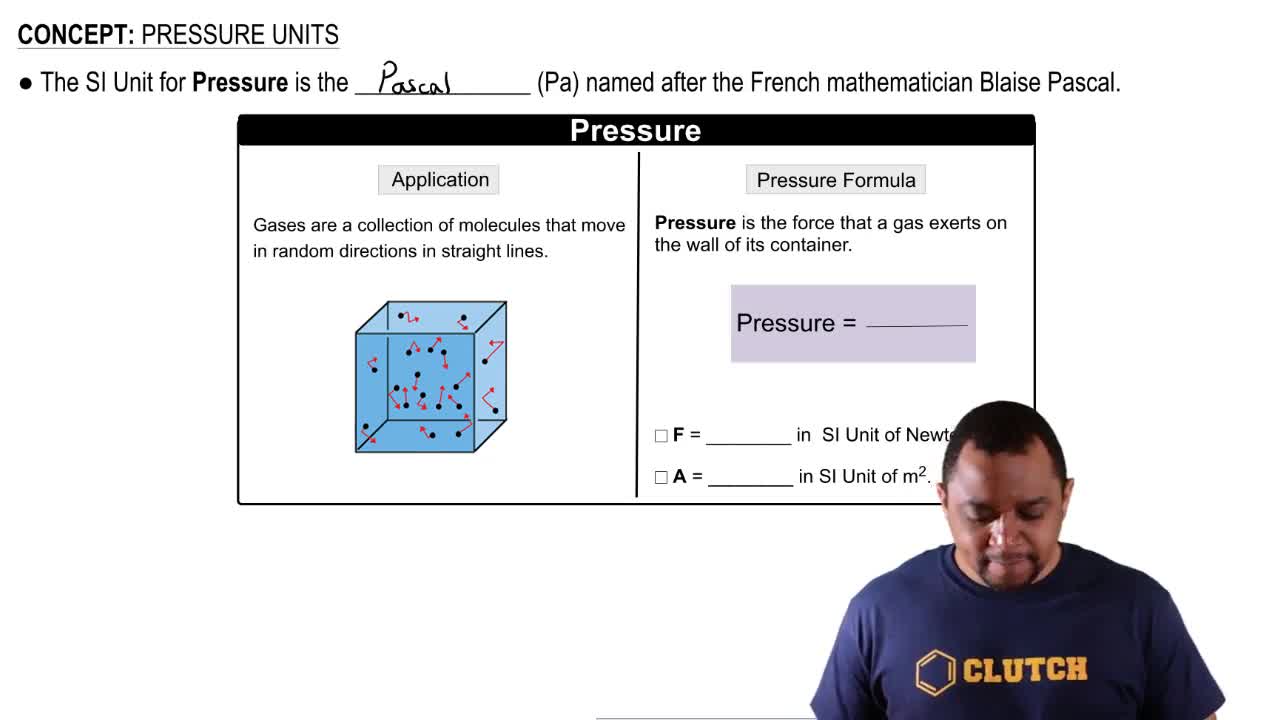
Pressure is a measure of the force exerted by a fluid per unit area. Common units for pressure include inches of mercury (in Hg), millimeters of mercury (mmHg), and pascals (Pa). Understanding how to convert between these units is essential for solving problems related to pressure in different contexts.
추천 영상:

Unit Conversion

Unit conversion involves changing a quantity expressed in one unit to another unit without changing its value. For pressure, the conversion between in Hg and mmHg is straightforward, as 1 in Hg is equivalent to 25.4 mmHg. Mastery of conversion factors is crucial for accurately interpreting and comparing measurements.
추천 영상:
가이드 코스
01:56
Conversion Factors

Barometric Pressure

Barometric pressure refers to the pressure exerted by the weight of the atmosphere at a given location. It varies with altitude, with lower pressures found at higher elevations. In Denver, the average pressure of 24.9 in Hg reflects its elevation of 5280 ft, which is important for understanding how atmospheric conditions affect pressure readings.
추천 영상: