Calculate the root mean square velocity and kinetic energy of CO, CO2, and SO3 at 298 K. Which gas has the greatest velocity? The greatest kinetic energy? The greatest effusion rate?
Ch.5 - Gases
5장, 문제 85
We separate U-235 from U-238 by fluorinating a sample of uranium to form UF6 (which is a gas) and then taking advantage of the different rates of effusion and diffusion for compounds containing the two isotopes. Calculate the ratio of effusion rates for 238UF6 and 235UF6. The atomic mass of U-235 is 235.054 amu and that of U-238 is 238.051 amu.
검증된 단계별 안내1
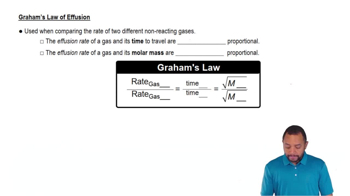
Identify the formula for effusion rates: Graham's law of effusion states that the rate of effusion of a gas is inversely proportional to the square root of its molar mass. Mathematically, this is expressed as \( \frac{r_1}{r_2} = \sqrt{\frac{M_2}{M_1}} \), where \( r_1 \) and \( r_2 \) are the effusion rates of gases 1 and 2, and \( M_1 \) and \( M_2 \) are their respective molar masses.
Determine the molar masses of \( ^{238}\text{UF}_6 \) and \( ^{235}\text{UF}_6 \): The molar mass of \( ^{238}\text{UF}_6 \) is the sum of the atomic mass of \( ^{238}\text{U} \) and six times the atomic mass of fluorine (\( 18.998 \text{ amu} \)). Similarly, calculate the molar mass for \( ^{235}\text{UF}_6 \).
Calculate the molar mass of \( ^{238}\text{UF}_6 \): \( M_{238} = 238.051 + 6 \times 18.998 \).
Calculate the molar mass of \( ^{235}\text{UF}_6 \): \( M_{235} = 235.054 + 6 \times 18.998 \).
Apply Graham's law to find the ratio of effusion rates: Substitute the molar masses into the formula \( \frac{r_{238}}{r_{235}} = \sqrt{\frac{M_{235}}{M_{238}}} \) to find the ratio of effusion rates for \( ^{238}\text{UF}_6 \) and \( ^{235}\text{UF}_6 \).

비슷한 문제에 대한 검증된 영상 답변:
이 영상 해법은 위 문제에 도움이 된다고 튜터들이 추천한 것입니다.
영상 길이:
1m주요 개념
질문에 올바르게 답하기 위해 반드시 이해해야 하는 핵심 개념들은 다음과 같습니다.
Effusion and Diffusion
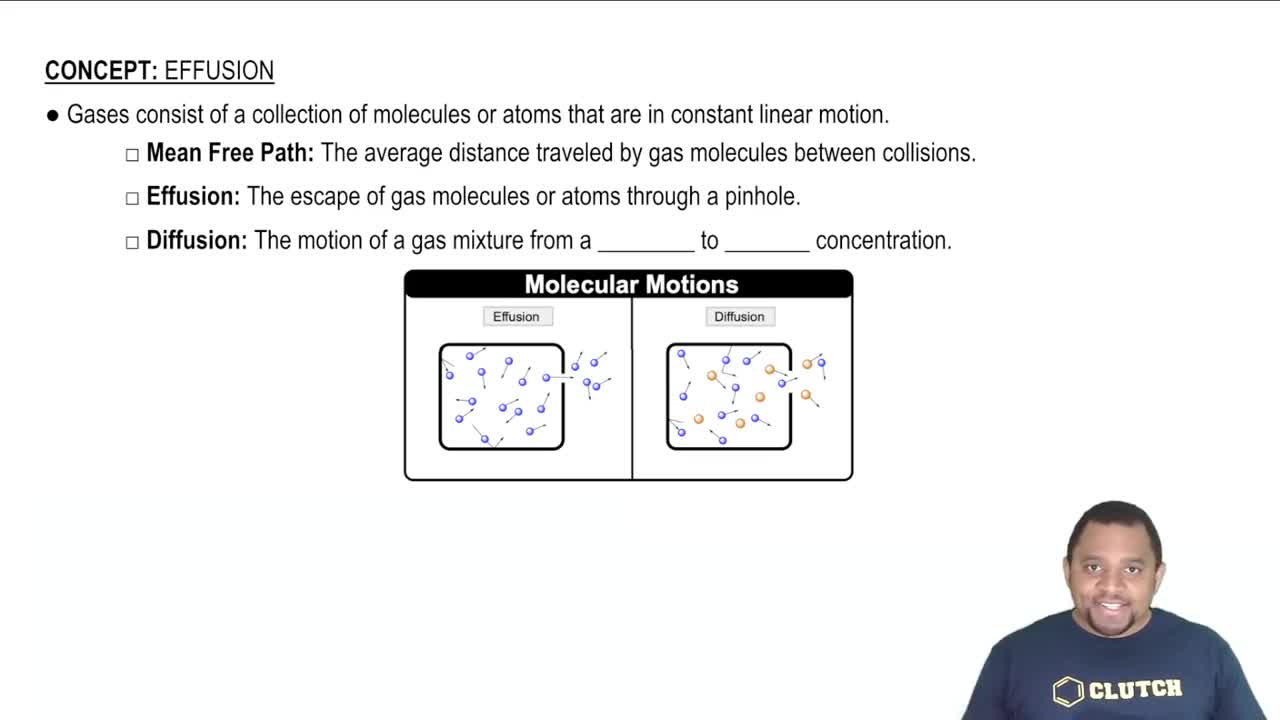
Effusion is the process by which gas molecules escape through a tiny hole into a vacuum, while diffusion is the spreading of gas molecules throughout a space. The rates of these processes depend on the mass of the gas molecules, with lighter molecules effusing and diffusing faster than heavier ones, as described by Graham's law.
추천 영상:
가이드 코스
Effusion vs Diffusion
Graham's Law of Effusion
Graham's Law states that the rate of effusion of a gas is inversely proportional to the square root of its molar mass. This means that if two gases have different molar masses, the lighter gas will effuse more quickly than the heavier gas, allowing for the calculation of effusion rates based on their respective masses.
추천 영상:
가이드 코스
Graham's Law of Effusion
Isotopes and Atomic Mass
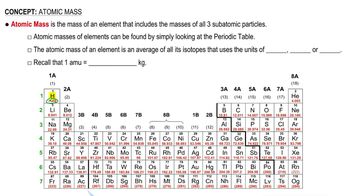
Isotopes are variants of a chemical element that have the same number of protons but different numbers of neutrons, resulting in different atomic masses. In this case, U-235 and U-238 are isotopes of uranium, and their differing atomic masses are crucial for calculating the ratio of their effusion rates, as lighter isotopes will effuse more rapidly.
추천 영상:
가이드 코스
Atomic Mass
관련 실천
교과서 질문
2059
views
1
comments
교과서 질문
Calculate the root mean square velocity and kinetic energy of F2, Cl2, and Br2 at 298 K. Rank these three halogens with respect to their rate of effusion.
1206
views
교과서 질문
Calculate the ratio of effusion rates for Ar and Kr.
1313
views
교과서 질문
A sample of neon effuses from a container in 76 seconds. The same amount of an unknown noble gas requires 155 seconds. Identify the second gas.
1758
views
1
comments
교과서 질문
A sample of N2O effuses from a container in 42 seconds. How long will it take the same amount of gaseous I2 to effuse from the same container under identical conditions?
3361
views
교과서 질문
Calculate the kinetic energy of F2, Cl2, and Br2 at 298 K.
1801
views
1
comments