Ch.6 - Thermochemistry
Tro - Chemistry: A Molecular Approach 4th Edition
Tro4th EditionChemistry: A Molecular ApproachISBN: 9780134112831당신이 사용하는 게 아니라요?교과서 변경
6장, 문제 117

A copper cube with an edge measuring 1.55 cm and an aluminum cube with an edge measuring 1.62 cm are both heated to 55.0 °C and submerged in 100.0 mL of water at 22.2 °C. What is the final temperature of the water when equilibrium is reached? (Assume a density of 0.998 g/mL for water.)

검증된 단계별 안내
1
Calculate the volume of each cube using the formula for the volume of a cube: \( V = a^3 \), where \( a \) is the edge length.
Determine the mass of each cube using the formula \( m = \rho \times V \), where \( \rho \) is the density of the material. Use the densities: copper (8.96 g/cm³) and aluminum (2.70 g/cm³).
Calculate the heat lost by each metal cube using the formula \( q = m \times c \times \Delta T \), where \( c \) is the specific heat capacity (copper: 0.385 J/g°C, aluminum: 0.897 J/g°C) and \( \Delta T \) is the change in temperature.
Calculate the heat gained by the water using the formula \( q = m \times c \times \Delta T \), where \( m \) is the mass of the water (100.0 mL \( \times \) 0.998 g/mL), \( c \) is the specific heat capacity of water (4.18 J/g°C), and \( \Delta T \) is the change in temperature.
Set the heat lost by the metal cubes equal to the heat gained by the water and solve for the final temperature \( T_f \) when equilibrium is reached.

주요 개념

질문에 올바르게 답하기 위해 반드시 이해해야 하는 핵심 개념들은 다음과 같습니다.

Heat Transfer and Thermal Equilibrium

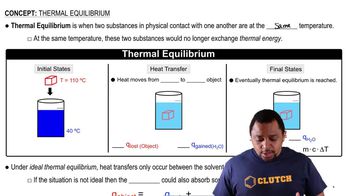
Heat transfer occurs when two objects at different temperatures come into contact, leading to energy exchange until thermal equilibrium is reached. In this scenario, the heat lost by the copper and aluminum cubes will equal the heat gained by the water, allowing us to calculate the final temperature when all three substances reach the same temperature.
추천 영상:
가이드 코스
02:35
Thermal Equilibrium

Specific Heat Capacity

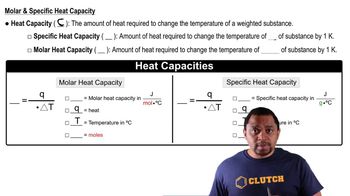
Specific heat capacity is the amount of heat required to raise the temperature of one gram of a substance by one degree Celsius. Each material has a unique specific heat capacity, which influences how much heat it can absorb or release. For this problem, knowing the specific heat capacities of copper, aluminum, and water is essential for calculating the final temperature.
추천 영상:

Mass and Volume Calculations

To determine the heat transfer in this problem, we need to calculate the mass of the cubes and the water. The mass can be derived from the volume and density of each substance. For water, the mass can be calculated using its density (0.998 g/mL) and the given volume (100.0 mL), while the mass of the cubes can be found using their volume and respective densities.
추천 영상:
가이드 코스
03:12
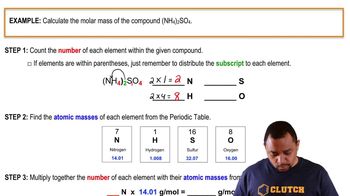
Molar Mass Calculation Example