Ch.6 - Thermochemistry
Tro - Chemistry: A Molecular Approach 4th Edition
Tro4th EditionChemistry: A Molecular ApproachISBN: 9780134112831당신이 사용하는 게 아니라요?교과서 변경
6장, 문제 107

Derive a relationship between ΔH and ΔE for a process in which the temperature of a fixed amount of an ideal gas changes.

검증된 단계별 안내
1
Start with the first law of thermodynamics: \( \Delta E = q + w \), where \( \Delta E \) is the change in internal energy, \( q \) is the heat exchanged, and \( w \) is the work done.
For an ideal gas, the work done by the system during expansion or compression at constant pressure is given by \( w = -P_{\text{ext}} \Delta V \), where \( P_{\text{ext}} \) is the external pressure and \( \Delta V \) is the change in volume.
The enthalpy change \( \Delta H \) is defined as \( \Delta H = \Delta E + P \Delta V \).
Substitute the expression for work into the first law equation: \( \Delta E = q - P_{\text{ext}} \Delta V \).
Combine the expressions for \( \Delta E \) and \( \Delta H \) to derive the relationship: \( \Delta H = q - P_{\text{ext}} \Delta V + P \Delta V = q + (P - P_{\text{ext}}) \Delta V \).

주요 개념

질문에 올바르게 답하기 위해 반드시 이해해야 하는 핵심 개념들은 다음과 같습니다.

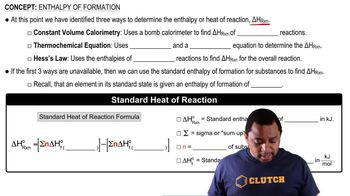
Enthalpy (ΔH)

Enthalpy (ΔH) is a thermodynamic quantity that represents the total heat content of a system at constant pressure. It accounts for the internal energy of the system plus the product of its pressure and volume. In processes involving gases, changes in enthalpy can be related to heat transfer, making it crucial for understanding energy changes during reactions or phase transitions.
추천 영상:
가이드 코스
02:34
Enthalpy of Formation

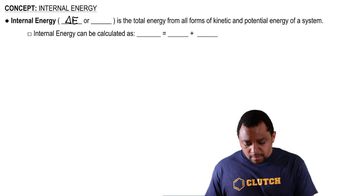
Internal Energy (ΔE)

Internal Energy (ΔE) is the total energy contained within a system, encompassing kinetic and potential energies of the particles. For an ideal gas, changes in internal energy are primarily due to changes in temperature. The relationship between internal energy and temperature is significant, as it helps in calculating energy changes during heating or cooling processes.
추천 영상:
가이드 코스
00:40
Internal Energy

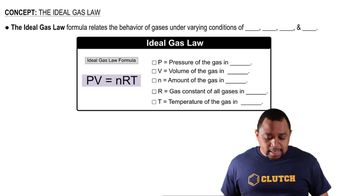
Ideal Gas Law

The Ideal Gas Law (PV = nRT) describes the behavior of ideal gases, relating pressure (P), volume (V), temperature (T), and the number of moles (n) of gas. This law is essential for deriving relationships between ΔH and ΔE, as it allows for the calculation of changes in state variables when temperature changes, providing a framework for understanding how energy is transferred in gas systems.
추천 영상:
가이드 코스
01:15
Ideal Gas Law Formula