Ch.6 - Thermochemistry
Tro - Chemistry: A Molecular Approach 4th Edition
Tro4th EditionChemistry: A Molecular ApproachISBN: 9780134112831당신이 사용하는 게 아니라요?교과서 변경
6장, 문제 77a

For each generic reaction, determine the value of ΔH2 in terms of ΔH1.
a. A + B → 2 C ΔH1
2 C→ A + B ΔH2 = ?

검증된 단계별 안내
1
insert step 1> Identify the type of reaction given in the problem. The first reaction is A + B \(\rightarrow\) 2C with an enthalpy change of \(\Delta\) H_1.
insert step 2> Recognize that the second reaction is the reverse of the first reaction: 2C \(\rightarrow\) A + B.
insert step 3> Understand that reversing a chemical reaction changes the sign of the enthalpy change. Therefore, \(\Delta\) H_2 will be the negative of \(\Delta\) H_1.
insert step 4> Express \(\Delta\) H_2 in terms of \(\Delta\) H_1: \(\Delta\) H_2 = -\(\Delta\) H_1.
insert step 5> Conclude that the enthalpy change for the reverse reaction is the negative of the enthalpy change for the forward reaction.

비슷한 문제에 대한 검증된 영상 답변:

이 영상 해법은 위 문제에 도움이 된다고 튜터들이 추천한 것입니다.
영상 길이:
5m

주요 개념

질문에 올바르게 답하기 위해 반드시 이해해야 하는 핵심 개념들은 다음과 같습니다.

Enthalpy Change (ΔH)

Enthalpy change (ΔH) is a measure of the heat content of a system at constant pressure. It indicates whether a reaction is exothermic (releases heat, ΔH < 0) or endothermic (absorbs heat, ΔH > 0). Understanding ΔH is crucial for predicting the energy changes associated with chemical reactions.
추천 영상:
가이드 코스
02:34
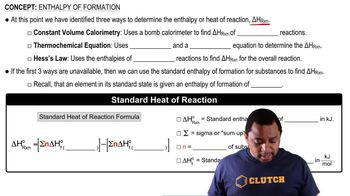
Enthalpy of Formation

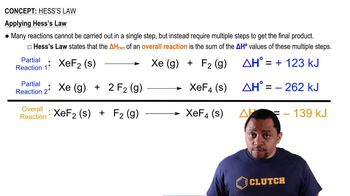
Hess's Law

Hess's Law states that the total enthalpy change for a reaction is the same, regardless of the number of steps taken to achieve the reaction. This principle allows us to calculate the enthalpy change of a reaction by using the enthalpy changes of related reactions, making it essential for determining ΔH2 in terms of ΔH1.
추천 영상:

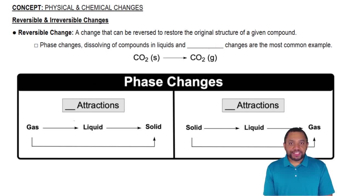
Reversible Reactions

Reversible reactions can proceed in both forward and reverse directions, allowing for the establishment of equilibrium. The relationship between the forward and reverse reactions is critical in determining the enthalpy changes, as the enthalpy change for the reverse reaction is equal in magnitude but opposite in sign to that of the forward reaction.
추천 영상:
가이드 코스
03:42
Reversible Changes in Matter
관련 실천
교과서 질문

For each generic reaction, determine the value of ΔH2 in terms of ΔH1.

b. A + 1/2 B → C ΔH1

2 A + B → 2 C ΔH2 = ?

1909
views

교과서 질문

Zinc metal reacts with hydrochloric acid according to the balanced equation: Zn(s) + 2 HCl(aq) → ZnCl2(aq) + H2(g) When 0.103 g of Zn(s) is combined with enough HCl to make 50.0 mL of solution in a coffee-cup calorimeter, all of the zinc reacts, raising the temperature of the solution from 22.5 °C to 23.7 °C. Find ΔHrxn for this reaction as written. (Use 1.0 g/mL for the density of the solution and 4.18 J/g•°C as the specific heat capacity.)

27264
views
교과서 질문

Instant cold packs used to ice athletic injuries on the field contain ammonium nitrate and water separated by a thin plastic divider. When the divider is broken, the ammonium nitrate dissolves according to the endothermic reaction: NH4NO3(s) → NH4+(aq) + NO3 (aq) In order to measure the enthalpy change for this reaction, 1.25 g of NH4NO3 is dissolved in enough water to make 25.0 mL of solution. The initial temperature is 25.8 °C and the final temperature (after the solid dissolves) is 21.9 °C. Calculate the change in enthalpy for the reaction in kJ. (Use 1.0 g/mL as the density of the solution and 4.18 J/g•°C as the specific heat capacity.)

3188
views
1
comments
교과서 질문

Consider the generic reaction:

A + 2 B → C + 3 D ΔH = 155 kJ

Determine the value of ΔH for each related reaction.

a. 3 A + 6 B → 3 C + 9 D

b. C + 3 D → A + 2 B

c. 1/2 C + 3/2 D → 1/2 A + B

1781
views
교과서 질문

For each generic reaction, determine the value of ΔH2 in terms of ΔH1.

c. A → B + 2 C ΔH1

1/2 B + C → 1/2 A ΔH2 = ?

373
views
교과서 질문

Mothballs are composed primarily of the hydrocarbon naphthalene (C10H8). When 1.025 g of naphthalene burns in a bomb calorimeter, the temperature rises from 24.25 °C to 32.33 °C. Find ΔErxn for the combustion of naphthalene. The heat capacity of the bomb calorimeter, determined in a separate experiment, is 5.11 kJ/°C.

3998
views