Ch.6 - Thermochemistry
Tro - Chemistry: A Molecular Approach 4th Edition
Tro4th EditionChemistry: A Molecular ApproachISBN: 9780134112831당신이 사용하는 게 아니라요?교과서 변경
6장, 문제 101a

Use standard enthalpies of formation to calculate the standard change in enthalpy for the melting of ice. (The ΔH°f for H2O(s) is –291.8 kJ/mol.)

검증된 단계별 안내
1
Identify the chemical equation for the phase change of ice melting, which is H2O(s) → H2O(l).
Find the standard enthalpy of formation (ΔH °f) for liquid water (H2O(l)). This value is typically found in a table of standard enthalpies of formation.
Use the given ΔH °f for solid water (H2O(s)), which is -291.8 kJ/mol.
Apply Hess's Law to calculate the standard change in enthalpy for the reaction. The formula to use is ΔH °rxn = ΔH °f (products) - ΔH °f (reactants).
Substitute the values into the formula: ΔH °rxn = ΔH °f (H2O(l)) - (-291.8 kJ/mol).

비슷한 문제에 대한 검증된 영상 답변:

이 영상 해법은 위 문제에 도움이 된다고 튜터들이 추천한 것입니다.
영상 길이:
3m

주요 개념

질문에 올바르게 답하기 위해 반드시 이해해야 하는 핵심 개념들은 다음과 같습니다.

Enthalpy of Formation

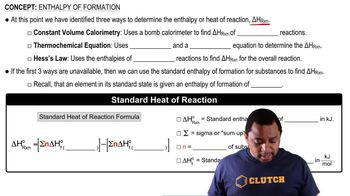
The standard enthalpy of formation (ΔH°f) is the change in enthalpy when one mole of a compound is formed from its elements in their standard states. It provides a reference point for calculating the enthalpy changes in chemical reactions, allowing chemists to predict the energy changes associated with the formation or transformation of substances.
추천 영상:
가이드 코스
02:34
Enthalpy of Formation

Phase Changes and Enthalpy

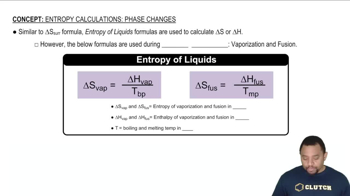
Phase changes, such as melting, involve energy changes that can be quantified using enthalpy. The enthalpy change for melting (ΔH_melting) is the energy required to convert a solid into a liquid at its melting point. Understanding this concept is crucial for calculating the overall enthalpy change when ice melts into water.
추천 영상:
가이드 코스
01:46
Entropy in Phase Changes

Hess's Law

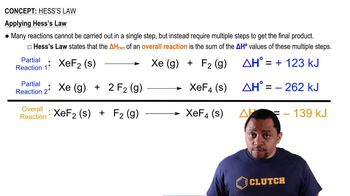
Hess's Law states that the total enthalpy change for a reaction is the sum of the enthalpy changes for individual steps, regardless of the pathway taken. This principle allows for the calculation of enthalpy changes in complex reactions by using known enthalpy values, such as the standard enthalpy of formation, to derive the enthalpy change for processes like melting ice.
추천 영상:
관련 실천
교과서 질문

Use standard enthalpies of formation to calculate the standard change in enthalpy for the melting of ice. (The ΔH°f for H2O(s) is –291.8 kJ/mol.) Use this value to calculate the mass of ice required to cool 355 mL of a beverage from room temperature (25.0 °C) to 0.0 °C. Assume that the specific heat capacity and density of the beverage are the same as those of water.

4255
views
1
rank
교과서 질문

Dry ice is solid carbon dioxide. Instead of melting, solid carbon dioxide sublimes according to the equation: CO2(s) → CO2(g) ◀ When carbon dioxide sublimes, the gaseous CO2 is cold enough to cause water vapor in the air to condense, forming fog. When dry ice is added to warm water, heat from the water causes the dry ice to sublime more quickly. The evaporating carbon dioxide produces a dense fog often used to create special effects. In a simple dry ice fog machine, dry ice is added to warm water in a Styrofoam cooler. The dry ice produces fog until it evaporates away, or until the water gets too cold to sublime the dry ice quickly enough. Suppose that a small Styrofoam cooler holds 15.0 L of water heated to 85 °C. Use standard enthalpies of formation to calculate the change in enthalpy for dry ice sublimation, and calculate the mass of dry ice that should be added to the water so that the dry ice completely sublimes away when the water reaches 25 °C. Assume no heat loss to the surroundings. (The ΔH°f for CO2(s) is –427.4 kJ/mol.)

1761
views
교과서 질문

A 25.5-g aluminum block is warmed to 65.4 °C and plunged into an insulated beaker containing 55.2 g water initially at 22.2 °C. The aluminum and the water are allowed to come to thermal equilibrium. Assuming that no heat is lost, what is the final temperature of the water and aluminum?

2496
views
1
rank
교과서 질문

LP gas burns according to the exothermic reaction: C3H8(g) + 5 O2(g) → 3 CO2(g) + 4 H2O(g) ΔH°rxn = –2044 kJ What mass of LP gas is necessary to heat 1.5 L of water from room temperature (25.0 °C) to boiling (100.0 °C)? Assume that during heating, 15% of the heat emitted by the LP gas combustion goes to heat the water. The rest is lost as heat to the surroundings.

2175
views
1
rank