An atomic emission spectrum of hydrogen shows three wavelengths: 1875 nm, 1282 nm, and 1093 nm. Assign these wavelengths to transitions in the hydrogen atom.
Ch.7 - Quantum-Mechanical Model of the Atom
7장, 문제 84
An atomic emission spectrum of hydrogen shows three wavelengths: 121.5 nm, 102.6 nm, and 97.23 nm. Assign these wavelengths to transitions in the hydrogen atom.
검증된 단계별 안내1
Identify the series of transitions in the hydrogen atom: Lyman, Balmer, and Paschen series.
Recognize that the Lyman series involves transitions to the n=1 energy level, Balmer to n=2, and Paschen to n=3.
Use the Rydberg formula for hydrogen: \( \frac{1}{\lambda} = R_H \left( \frac{1}{n_1^2} - \frac{1}{n_2^2} \right) \), where \( R_H \) is the Rydberg constant, \( n_1 \) is the lower energy level, and \( n_2 \) is the higher energy level.
Calculate the possible transitions for each wavelength using the Rydberg formula, starting with the Lyman series (n=1) since the given wavelengths are in the ultraviolet range.
Assign each wavelength to a specific transition by matching the calculated wavelengths to the given ones, confirming they belong to the Lyman series.

비슷한 문제에 대한 검증된 영상 답변:
이 영상 해법은 위 문제에 도움이 된다고 튜터들이 추천한 것입니다.
영상 길이:
6m주요 개념
질문에 올바르게 답하기 위해 반드시 이해해야 하는 핵심 개념들은 다음과 같습니다.
Atomic Emission Spectrum
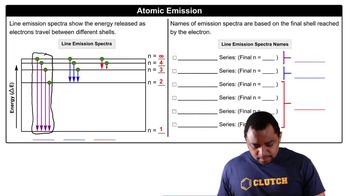
An atomic emission spectrum is a spectrum of the electromagnetic radiation emitted by a substance when its atoms transition from a higher energy state to a lower energy state. Each element has a unique emission spectrum, which can be used to identify the element and its electronic transitions. In hydrogen, these transitions correspond to specific wavelengths that can be observed in the ultraviolet region of the spectrum.
추천 영상:
가이드 코스
Atomic Emission Spectra
Energy Levels in Hydrogen Atom
The hydrogen atom has quantized energy levels, which are defined by the principal quantum number (n). Electrons can occupy these discrete energy levels, and when they absorb energy, they can jump to a higher level. When they return to a lower energy level, they emit energy in the form of light at specific wavelengths, which correspond to the differences in energy between the levels.
추천 영상:
가이드 코스
Hydrogenation Reactions
Balmer and Lyman Series
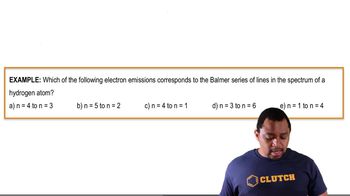
The Balmer and Lyman series are sets of spectral lines corresponding to electron transitions in the hydrogen atom. The Lyman series involves transitions to the n=1 level and emits ultraviolet light, while the Balmer series involves transitions to the n=2 level and emits visible light. The wavelengths provided in the question correspond to transitions in the Lyman series, specifically from n=2 to n=1 and n=3 to n=1.
추천 영상:
가이드 코스
Balmer Series Example
관련 실천
교과서 질문
3025
views
교과서 질문
Suppose that, in an alternate universe, the possible values of ml are the integer values including 0 ranging from -l -1 to l +1 (instead of simply -l to +l). How many orbitals exist in each sublevel? a. s sublevel b. p sublevel c. d sublevel
1155
views
교과서 질문
Suppose that in an alternate universe, the possible values of l are the integer values from 0 to n (instead of 0 to n - 1). Assuming no other differences between this imaginary universe and ours, how many orbitals would exist in each level? a. n = 1 b. n = 2 c. n = 3
1074
views
교과서 질문
The speed of sound in air is 344 m/s at room temperature. The lowest frequency of a large organ pipe is 30 s–1 and the highest frequency of a piccolo is 1.5×10⁴ s–1. Find the difference in wavelength between these two sounds.
2299
views
1
comments