Ch.7 - Quantum-Mechanical Model of the Atom
Tro - Chemistry: A Molecular Approach 4th Edition
Tro4th EditionChemistry: A Molecular ApproachISBN: 9780134112831당신이 사용하는 게 아니라요?교과서 변경
7장, 문제 53

Calculate the de Broglie wavelength of a 143-g baseball traveling at 95 mph. Why is the wave nature of matter not important for a baseball?

검증된 단계별 안내
1
Convert the mass of the baseball from grams to kilograms by dividing by 1000.
Convert the speed of the baseball from miles per hour (mph) to meters per second (m/s) using the conversion factor: 1 mph = 0.44704 m/s.
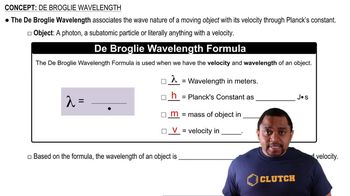
Use the de Broglie wavelength formula: \( \lambda = \frac{h}{mv} \), where \( h \) is Planck's constant \( 6.626 \times 10^{-34} \text{ m}^2 \text{ kg/s} \), \( m \) is the mass in kilograms, and \( v \) is the velocity in meters per second.
Substitute the values of \( h \), \( m \), and \( v \) into the de Broglie wavelength formula to find \( \lambda \).
Discuss why the wave nature of matter is not important for a baseball: The de Broglie wavelength is extremely small compared to the size of the baseball, making wave properties negligible in macroscopic objects.

비슷한 문제에 대한 검증된 영상 답변:

이 영상 해법은 위 문제에 도움이 된다고 튜터들이 추천한 것입니다.

주요 개념

질문에 올바르게 답하기 위해 반드시 이해해야 하는 핵심 개념들은 다음과 같습니다.

de Broglie Wavelength

The de Broglie wavelength is a concept in quantum mechanics that describes the wave-like behavior of particles. It is calculated using the formula λ = h/p, where λ is the wavelength, h is Planck's constant, and p is the momentum of the particle. This wavelength becomes significant for microscopic particles, such as electrons, but is negligible for macroscopic objects like a baseball.
추천 영상:
가이드 코스
00:58
De Broglie Wavelength Formula

Momentum

Momentum is a physical quantity defined as the product of an object's mass and its velocity (p = mv). It is a vector quantity, meaning it has both magnitude and direction. In the context of the de Broglie wavelength, momentum is crucial because it directly influences the wavelength; larger momentum results in a shorter wavelength, making wave properties less observable in larger objects.
추천 영상:
가이드 코스
00:40
Angular Momentum Quantum Number

Wave-Particle Duality

Wave-particle duality is a fundamental principle of quantum mechanics stating that every particle exhibits both wave-like and particle-like properties. While this duality is significant for small particles, such as photons and electrons, it is not observable in larger objects like a baseball due to their relatively large mass and momentum, which result in extremely short de Broglie wavelengths that are practically unnoticeable.
추천 영상:
가이드 코스
05:19
Subatomic Particles