Determine whether each transition in the hydrogen atom corresponds to absorption or emission of energy. a. n = 3 → n = 1 b. n = 2 → n = 4 c. n = 4 → n = 3
Ch.7 - Quantum-Mechanical Model of the Atom
7장, 문제 69
Calculate the wavelength of the light emitted when an electron in a hydrogen atom makes each transition and indicate the region of the electromagnetic spectrum (infrared, visible, ultraviolet, etc.) where the light is found. a. n = 2 → n = 1 b. n = 3 → n = 1 c. n = 4 → n = 2 d. n = 5 → n = 2
검증된 단계별 안내1
Identify the formula to calculate the wavelength of light emitted during an electron transition in a hydrogen atom: \( \frac{1}{\lambda} = R_H \left( \frac{1}{n_1^2} - \frac{1}{n_2^2} \right) \), where \( R_H \) is the Rydberg constant (1.097 \(\times\) 10^7 \(\text{ m}\)^{-1}), \( n_1 \) is the lower energy level, and \( n_2 \) is the higher energy level.
For each transition, substitute the given values of \( n_1 \) and \( n_2 \) into the formula to find \( \frac{1}{\lambda} \).
Calculate \( \lambda \) by taking the reciprocal of \( \frac{1}{\lambda} \).
Convert the wavelength from meters to nanometers by multiplying by \( 10^9 \) (since 1 m = 10^9 nm).
Determine the region of the electromagnetic spectrum by comparing the calculated wavelength to known ranges: infrared (> 700 nm), visible (400-700 nm), ultraviolet (< 400 nm).

비슷한 문제에 대한 검증된 영상 답변:
이 영상 해법은 위 문제에 도움이 된다고 튜터들이 추천한 것입니다.
영상 길이:
15m주요 개념
질문에 올바르게 답하기 위해 반드시 이해해야 하는 핵심 개념들은 다음과 같습니다.
Energy Levels in Hydrogen Atom
In a hydrogen atom, electrons occupy specific energy levels, denoted by quantum numbers (n). When an electron transitions between these levels, it either absorbs or emits energy in the form of light. The energy difference between the levels determines the wavelength of the emitted light, which can be calculated using the Rydberg formula.
추천 영상:
가이드 코스
Hydrogenation Reactions
Wavelength and Frequency Relationship
The wavelength of light is inversely related to its frequency, as described by the equation c = λν, where c is the speed of light, λ is the wavelength, and ν is the frequency. This relationship is crucial for determining the wavelength of light emitted during electron transitions in the hydrogen atom, as the energy of the emitted photon can be calculated from the frequency.
추천 영상:
가이드 코스
Frequency-Wavelength Relationship
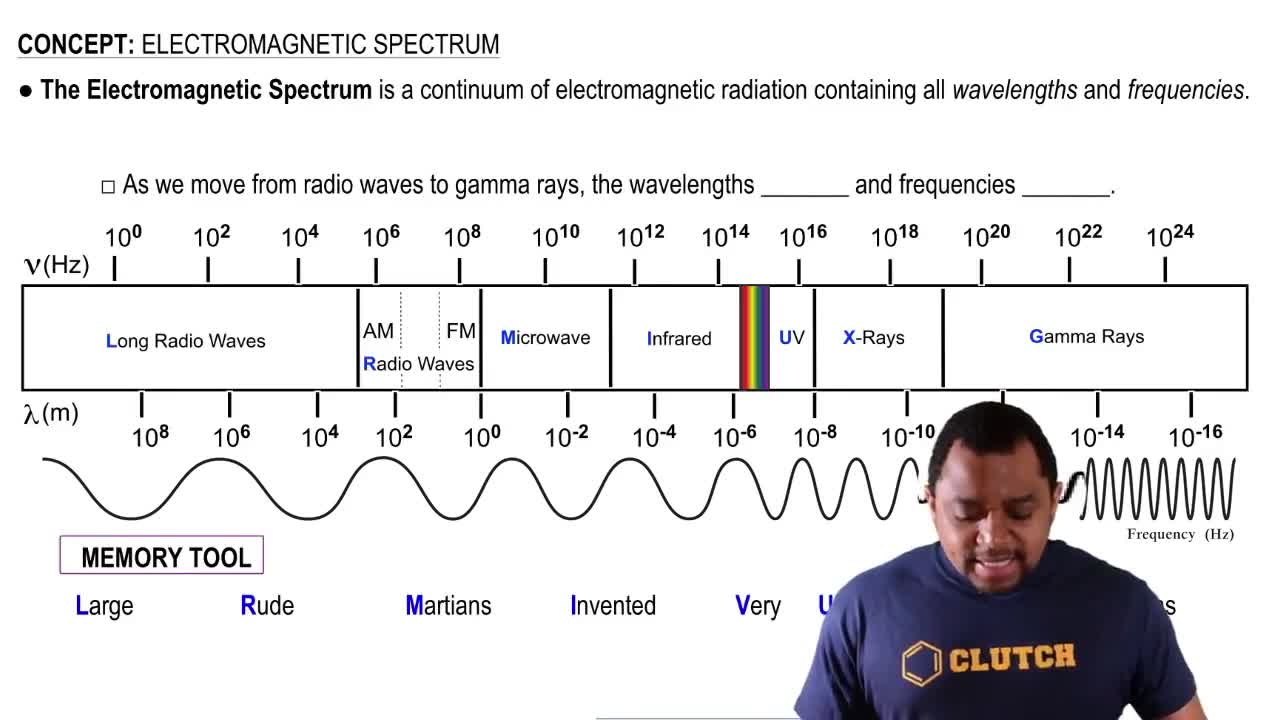
Regions of the Electromagnetic Spectrum
The electromagnetic spectrum is divided into various regions based on wavelength and frequency, including infrared, visible, and ultraviolet light. The wavelength calculated from electron transitions in a hydrogen atom will fall into one of these regions, which helps in identifying the type of light emitted. For example, transitions from higher energy levels often result in ultraviolet light, while lower energy transitions may emit visible or infrared light.
추천 영상:
가이드 코스
Electromagnetic Spectrum
관련 실천
교과서 질문
3571
views
3
rank
교과서 질문
An electron in the n = 7 level of the hydrogen atom relaxes to a lower-energy level, emitting light of 397 nm. What is the value of n for the level to which the electron relaxed?
8549
views
5
rank
2
comments
교과서 질문
According to the quantum-mechanical model for the hydrogen atom, which electron transition produces light with the longer wavelength: 3p → 2s or 4p → 3p?
1091
views
2
comments
교과서 질문
Calculate the frequency of the light emitted when an electron in a hydrogen atom makes each transition: a. n = 4 → n = 3 b. n = 5 → n = 1 c. n = 5 → n = 4 d. n = 6 → n = 5
8404
views
1
rank
교과서 질문
An electron in a hydrogen atom relaxes to the n = 4 level, emitting light of 114 THz. What is the value of n for the level in which the electron originated?
4997
views
2
rank
2
comments