Ch.7 - Quantum-Mechanical Model of the Atom
Tro - Chemistry: A Molecular Approach 4th Edition
Tro4th EditionChemistry: A Molecular ApproachISBN: 9780134112831당신이 사용하는 게 아니라요?교과서 변경
7장, 문제 61

Which set of quantum numbers cannot occur together to specify an orbital? a. n = 2, l = 1, ml = -1 b. n = 3, l = 2, ml = 0 c. n = 3, l = 3, ml = 2 d. n = 4, l = 3, ml = 0

검증된 단계별 안내
1
Identify the principal quantum number (n), which indicates the energy level and size of the orbital. It must be a positive integer.
Check the azimuthal quantum number (l), which defines the shape of the orbital. It must be an integer ranging from 0 to n-1.
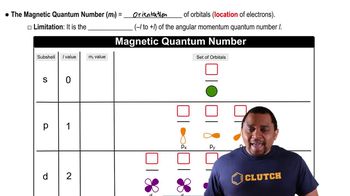
Examine the magnetic quantum number (ml), which describes the orientation of the orbital in space. It must be an integer ranging from -l to +l.
Review each set of quantum numbers to ensure that the values of l and ml are within the allowed ranges based on the value of n.
Identify any set where l is not less than n, or where ml is not within the range of -l to +l, as these would be quantum numbers that cannot occur together.

비슷한 문제에 대한 검증된 영상 답변:

이 영상 해법은 위 문제에 도움이 된다고 튜터들이 추천한 것입니다.
영상 길이:
3m
도움이 되었나요?

주요 개념

질문에 올바르게 답하기 위해 반드시 이해해야 하는 핵심 개념들은 다음과 같습니다.

Quantum Numbers

Quantum numbers are a set of four numbers that describe the unique quantum state of an electron in an atom. They include the principal quantum number (n), azimuthal quantum number (l), magnetic quantum number (ml), and spin quantum number (ms). Each number has specific rules governing its possible values, which are essential for determining the electron's energy level, shape, orientation, and spin.
추천 영상:
가이드 코스
02:55
Principal Quantum Number

Principal Quantum Number (n)

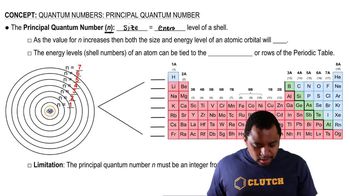
The principal quantum number (n) indicates the main energy level or shell of an electron in an atom. It can take positive integer values (1, 2, 3, ...), with higher values corresponding to higher energy levels and greater distances from the nucleus. The value of n determines the overall size and energy of the orbital.
추천 영상:
가이드 코스
02:55
Principal Quantum Number

Azimuthal Quantum Number (l)

The azimuthal quantum number (l) defines the shape of the orbital and can take integer values from 0 to (n-1). Each value of l corresponds to a specific type of orbital: 0 for s, 1 for p, 2 for d, and 3 for f orbitals. The value of l must always be less than n, which is crucial for determining valid combinations of quantum numbers.
추천 영상:
가이드 코스
03:06
Magnetic Quantum Number