Ch.8 - Periodic Properties of the Elements
Tro - Chemistry: A Molecular Approach 4th Edition
Tro4th EditionChemistry: A Molecular ApproachISBN: 9780134112831당신이 사용하는 게 아니라요?교과서 변경
8장, 문제 76

Arrange these elements in order of decreasing first ionization energy: Cl, S, Sn, Pb.

검증된 단계별 안내
1
Understand that first ionization energy is the energy required to remove the outermost electron from a neutral atom in the gaseous state.
Recall that ionization energy generally increases across a period (from left to right) and decreases down a group (from top to bottom) in the periodic table.
Identify the positions of the given elements in the periodic table: Cl (Chlorine) and S (Sulfur) are in the same period, while Sn (Tin) and Pb (Lead) are in the same group.
Compare Cl and S: Since Cl is to the right of S in the same period, Cl has a higher first ionization energy than S.
Compare Sn and Pb: Since Sn is above Pb in the same group, Sn has a higher first ionization energy than Pb.

주요 개념

질문에 올바르게 답하기 위해 반드시 이해해야 하는 핵심 개념들은 다음과 같습니다.

Ionization Energy

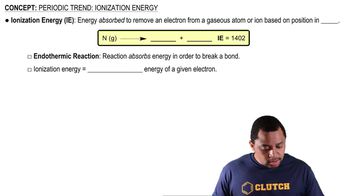
Ionization energy is the energy required to remove an electron from an atom in its gaseous state. It is a key factor in determining an element's reactivity and is influenced by the atomic structure, including the number of protons and the distance of the outer electrons from the nucleus.
추천 영상:
가이드 코스
01:19
Ionization Energy

Trends in the Periodic Table

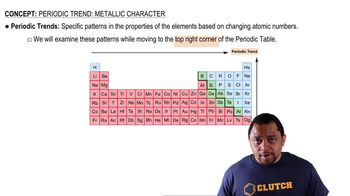
Ionization energy generally increases across a period from left to right due to increasing nuclear charge, which holds electrons more tightly. Conversely, it decreases down a group as the outer electrons are farther from the nucleus and experience greater shielding from inner electrons, making them easier to remove.
추천 영상:
가이드 코스
00:38
Periodic Trends

Comparison of Elements

When comparing elements like Cl, S, Sn, and Pb, it is essential to consider their positions in the periodic table. Chlorine (Cl) is a non-metal in period 3, sulfur (S) is also a non-metal in period 3, while tin (Sn) and lead (Pb) are metals in periods 5 and 6, respectively, which typically have lower ionization energies due to their larger atomic radii and increased electron shielding.
추천 영상:
가이드 코스
02:35
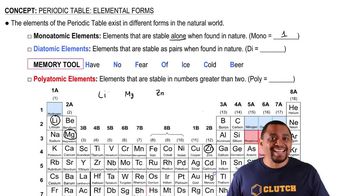
Elemental Forms of Elements