Choose the element with the more negative (more exothermic) electron affinity in each pair. a. Mg or S b. K or Cs c. Si or P d. Ga or Br
Ch.8 - Periodic Properties of the Elements
8장, 문제 79b
Choose the element with the more negative (more exothermic) electron affinity from each pair. b. B or S
검증된 단계별 안내1
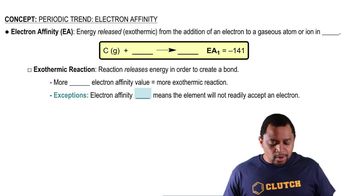
Understand the concept of electron affinity: Electron affinity is the energy change that occurs when an electron is added to a neutral atom in the gaseous state to form a negative ion. A more negative electron affinity indicates a greater tendency to accept an electron.
Identify the position of each element in the periodic table: Boron (B) is in Group 13 and Period 2, while Sulfur (S) is in Group 16 and Period 3.
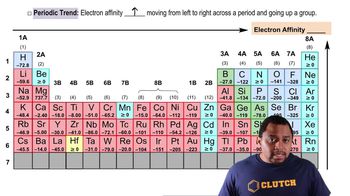
Recall the general trend for electron affinity in the periodic table: Electron affinity generally becomes more negative across a period from left to right and less negative down a group.
Compare the elements based on their positions: Since Sulfur (S) is to the right of Boron (B) in the same period, it is expected to have a more negative electron affinity.
Conclude which element has the more negative electron affinity: Based on periodic trends, Sulfur (S) is expected to have a more negative (more exothermic) electron affinity than Boron (B).

비슷한 문제에 대한 검증된 영상 답변:
이 영상 해법은 위 문제에 도움이 된다고 튜터들이 추천한 것입니다.
영상 길이:
1m도움이 되었나요?
주요 개념
질문에 올바르게 답하기 위해 반드시 이해해야 하는 핵심 개념들은 다음과 같습니다.
Electron Affinity
Electron affinity is the amount of energy released when an electron is added to a neutral atom in the gas phase. A more negative electron affinity indicates a greater release of energy, meaning the atom has a stronger attraction for the added electron. This property is crucial for understanding how elements interact with electrons and form ions.
추천 영상:
가이드 코스
Electron Affinity
Trends in Electron Affinity
Electron affinity varies across the periodic table, generally increasing (becoming more negative) from left to right and decreasing (becoming less negative) from top to bottom. This trend is influenced by atomic size and effective nuclear charge, which affect how tightly an atom can hold onto its electrons. Recognizing these trends helps predict the behavior of elements in chemical reactions.
추천 영상:
가이드 코스
Electron Affinity Trends
Comparison of Elements
When comparing elements like boron (B) and sulfur (S), it is essential to consider their positions in the periodic table. Sulfur, being further to the right and lower in the table than boron, typically has a more negative electron affinity due to its higher effective nuclear charge and smaller atomic radius, which allows it to attract additional electrons more effectively.
추천 영상:
가이드 코스
Elemental Forms of Elements
관련 실천
교과서 질문
699
views
1
rank
교과서 질문
Choose the element with the more negative (more exothermic) electron affinity from each pair. a. Na or Rb
2072
views
교과서 질문
Consider this set of ionization energies. IE1 = 578 kJ/mol IE2 = 1820 kJ/mol IE3 = 2750 kJ/mol IE4 = 11,600 kJ/mol To which third-period element do these ionization values belong?
5849
views
1
comments
교과서 질문
Choose the element with the more negative (more exothermic) electron affinity from each pair. c. C or N d. Li or F
324
views
교과서 질문
Choose the more metallic element from each pair. c. Cl or O
741
views
교과서 질문
For each element, predict where the 'jump' occurs for successive ionization energies. (For example, does the jump occur between the first and second ionization energies, the second and third, or the third and fourth?) a. Be b. N c. O d. Li
3121
views