Ch.8 - Periodic Properties of the Elements
Tro - Chemistry: A Molecular Approach 4th Edition
Tro4th EditionChemistry: A Molecular ApproachISBN: 9780134112831당신이 사용하는 게 아니라요?교과서 변경
8장, 문제 50b

Name an element in the third period (row) of the periodic table with the following: b. four 3p electrons

검증된 단계별 안내
1
First, remember that the third period of the periodic table corresponds to the third energy level, or n=3. This period includes the 3s and 3p sublevels.
Next, recall that the 3p sublevel can hold up to six electrons. The question specifies an element with four 3p electrons.
Then, consider that the 3p sublevel starts filling after the 3s sublevel is full. So, an element with four 3p electrons would have a full 3s sublevel with two electrons, and four electrons in the 3p sublevel.
Counting from the start of the third period (which begins with Sodium, Na), find the element that is the sixth one in. This is because the first two electrons go into the 3s sublevel, and the next four (the 3p electrons) make up the next four elements.
Finally, identify the element in the third period of the periodic table with four 3p electrons. Remember not to calculate the final result, but to guide the student to find the answer themselves.

비슷한 문제에 대한 검증된 영상 답변:

이 영상 해법은 위 문제에 도움이 된다고 튜터들이 추천한 것입니다.
영상 길이:
46s

주요 개념

질문에 올바르게 답하기 위해 반드시 이해해야 하는 핵심 개념들은 다음과 같습니다.

Periodic Table Structure

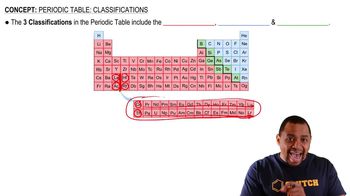
The periodic table is organized into rows (periods) and columns (groups) based on atomic number and electron configuration. Elements in the same period have the same number of electron shells, while groups share similar chemical properties. The third period includes elements from sodium (Na) to argon (Ar), each with increasing atomic numbers and distinct electron configurations.
추천 영상:
가이드 코스
02:40
Periodic Table Classifications

Electron Configuration

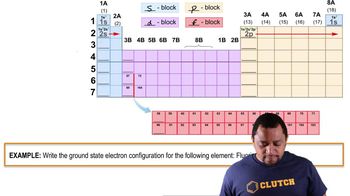
Electron configuration describes the distribution of electrons in an atom's orbitals. For elements in the third period, the electron configuration includes the filling of the 3s and 3p orbitals. The notation indicates the number of electrons in each subshell, which is crucial for understanding an element's chemical behavior and bonding characteristics.
추천 영상:
가이드 코스
01:33
Electron Configuration Example

Valence Electrons

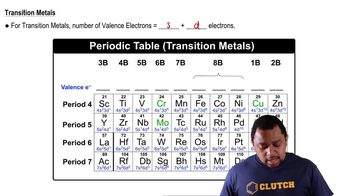
Valence electrons are the outermost electrons of an atom and play a key role in chemical bonding and reactivity. In the context of the third period, elements can have varying numbers of valence electrons depending on their position. An element with four 3p electrons would have a total of four valence electrons, influencing its ability to form bonds and its overall chemical properties.
추천 영상:
가이드 코스
02:12
Transition Metals Valence Electrons