Ch.8 - Periodic Properties of the Elements

Tro4th EditionChemistry: A Molecular ApproachISBN: 9780134112831
당신이 사용하는 게 아니라요?교과서 변경다른 교과서를 선택하세요
TOC.tableOfContents
- Ch.1 - Matter, Measurement & Problem Solving136
- Ch.2 - Atoms & Elements112
- Ch.3 - Molecules, Compounds & Chemical Equations159
- Ch.4 - Chemical Quantities & Aqueous Reactions140
- Ch.5 - Gases118
- Ch.6 - Thermochemistry106
- Ch.7 - Quantum-Mechanical Model of the Atom62
- Ch.8 - Periodic Properties of the Elements103
- Ch.9 - Chemical Bonding I: The Lewis Model104
- Ch.10 - Chemical Bonding II: Molecular Shapes & Valence Bond Theory89
- Ch.11 - Liquids, Solids & Intermolecular Forces73
- Ch.12 - Solids and Modern Material59
- Ch.13 - Solutions110
- Ch.14 - Chemical Kinetics140
- Ch.15 - Chemical Equilibrium78
- Ch.16 - Acids and Bases155
- Ch.17 - Aqueous Ionic Equilibrium176
- Ch.18 - Free Energy and Thermodynamics108
- Ch.19 - Electrochemistry118
- Ch.20 - Radioactivity and Nuclear Chemistry82
- Ch.21 - Organic Chemistry150

8장, 문제 103
The lightest noble gases, such as helium and neon, are completely inert—they do not form any chemical compounds whatsoever. In contrast, the heavier noble gases do form a limited number of compounds. Explain this difference in terms of trends in fundamental periodic properties.
 검증된 단계별 안내
1
insert step 1> The noble gases are located in Group 18 of the periodic table and are known for their lack of reactivity due to having a complete valence electron shell.
insert step 2> Helium and neon, the lightest noble gases, have very high ionization energies and small atomic radii, making it difficult for them to participate in chemical bonding.
insert step 3> As you move down the group from helium to heavier noble gases like xenon and radon, the atomic size increases, and the ionization energy decreases.
insert step 4> The decrease in ionization energy and increase in atomic size for heavier noble gases make it easier for them to form compounds, as they can more readily share or transfer electrons.
insert step 5> Additionally, the presence of d and f orbitals in heavier noble gases allows for expanded valence shells, facilitating the formation of compounds under certain conditions.
주요 개념
질문에 올바르게 답하기 위해 반드시 이해해야 하는 핵심 개념들은 다음과 같습니다.
Noble Gas Stability
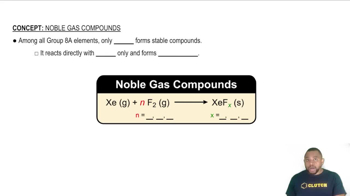
Noble gases are characterized by having a complete valence shell, which makes them highly stable and unreactive. Helium and neon, being the lightest noble gases, have full outer electron shells that do not seek additional electrons, resulting in their inert nature. In contrast, heavier noble gases have larger atomic radii and can exhibit some reactivity under specific conditions, leading to the formation of compounds.
추천 영상:
가이드 코스
 00:59
00:59
Noble Gas Compounds
Atomic Size and Reactivity
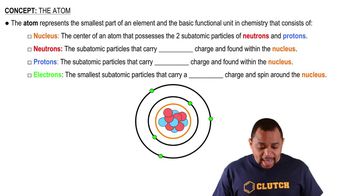
As you move down the periodic table, atomic size increases due to the addition of electron shells. This increase in size affects the reactivity of noble gases; heavier noble gases have more diffuse electron clouds, which can lead to interactions with other elements. The larger atomic radius can allow for some degree of polarization, enabling these gases to form weak bonds in certain compounds.
추천 영상:
가이드 코스
 02:10
02:10Atom Structure
Electronegativity and Bond Formation
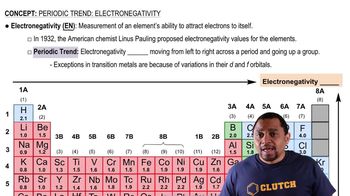
Electronegativity is a measure of an atom's ability to attract and hold onto electrons. While noble gases generally have low electronegativity, heavier noble gases can exhibit slight electronegativity due to their larger size and the presence of more electrons. This allows them to engage in limited bonding with highly electronegative elements, resulting in the formation of a few stable compounds.
추천 영상:
가이드 코스
 02:10
02:10Electronegativity Trends
관련 실천