Ch.8 - Periodic Properties of the Elements
Tro - Chemistry: A Molecular Approach 4th Edition
Tro4th EditionChemistry: A Molecular ApproachISBN: 9780134112831당신이 사용하는 게 아니라요?교과서 변경
8장, 문제 65c,d,e

Write the electron configuration for each ion. c. Sr2+ d. Co3+ e. Cu2+

검증된 단계별 안내
1
Identify the atomic number of the neutral atom for each element: Sr (38), Co (27), Cu (29).
Write the electron configuration for the neutral atom: Sr: [Kr] 5s^2, Co: [Ar] 3d^7 4s^2, Cu: [Ar] 3d^10 4s^1.
For Sr^2+, remove 2 electrons from the outermost shell of Sr: Remove from 5s orbital.
For Co^3+, remove 3 electrons starting from the outermost shell of Co: Remove from 4s and then 3d orbitals.
For Cu^2+, remove 2 electrons starting from the outermost shell of Cu: Remove from 4s and then 3d orbitals.

비슷한 문제에 대한 검증된 영상 답변:

이 영상 해법은 위 문제에 도움이 된다고 튜터들이 추천한 것입니다.
영상 길이:
8m
도움이 되었나요?

주요 개념

질문에 올바르게 답하기 위해 반드시 이해해야 하는 핵심 개념들은 다음과 같습니다.

Electron Configuration

Electron configuration describes the distribution of electrons in an atom's orbitals. It is represented using a notation that indicates the energy levels and sublevels occupied by electrons. Understanding electron configuration is essential for predicting an element's chemical behavior and reactivity.
추천 영상:
가이드 코스
01:33
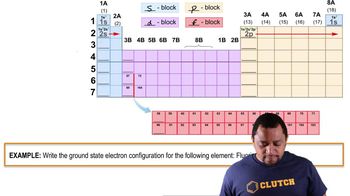
Electron Configuration Example

Ionic Charge and Electron Loss

Ionic charge refers to the net charge of an ion, which results from the loss or gain of electrons. For cations, such as Sr<sup>2+</sup>, Co<sup>3+</sup>, and Cu<sup>2+</sup>, electrons are lost, leading to a positive charge. The number of electrons lost is crucial for determining the correct electron configuration of the ion.
추천 영상:

Transition Metals and Electron Configuration

Transition metals often exhibit unique electron configurations due to their partially filled d orbitals. The electron configuration of transition metal ions can differ from their neutral atoms, as they may lose electrons from both the s and d orbitals. This is particularly relevant for ions like Co<sup>3+</sup> and Cu<sup>2+</sup>, where understanding the specific electron loss is key to writing their configurations.
추천 영상:
가이드 코스
00:53
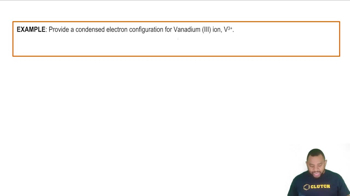
Electron Configurations Of Transition Metals Example