Ch.9 - Chemical Bonding I: The Lewis Model
Tro - Chemistry: A Molecular Approach 4th Edition
Tro4th EditionChemistry: A Molecular ApproachISBN: 9780134112831당신이 사용하는 게 아니라요?교과서 변경
9장, 문제 97

The cyanate ion (OCN-) and the fulminate ion (CNO-) share the same three atoms but have vastly different properties. The cyanate ion is stable, while the fulminate ion is unstable and forms explosive compounds. The resonance structures of the cyanate ion are explored in Example 9.8. Draw Lewis structures for the fulminate ion—including possible resonance forms— and use formal charge to explain why the fulminate ion is less stable (and therefore more reactive) than the cyanate ion.

검증된 단계별 안내
1
Step 1: Draw the Lewis structure for the fulminate ion (CNO-). Start by counting the total number of valence electrons. Carbon has 4, Nitrogen has 5, Oxygen has 6, and there is an extra electron due to the negative charge, giving a total of 16 electrons.
Step 2: Arrange the atoms. The least electronegative atom usually goes in the center, but in this case, we know from the formula that Carbon is in the center. Connect the atoms with single bonds. This uses up 6 electrons, leaving 10.
Step 3: Fill the octets of the outer atoms first. Oxygen needs 6 more electrons and Nitrogen needs 3 more, using up all 10 remaining electrons. At this point, all atoms have full octets except for Carbon, which only has 6 electrons.
Step 4: To give Carbon a full octet, we can move one of the lone pairs from Nitrogen to form a double bond with Carbon. This is one possible structure for the fulminate ion, but it has a formal charge of -1 on Nitrogen and +1 on Carbon, which is not ideal because Carbon is less electronegative than Nitrogen.
Step 5: Draw resonance structures. We can also move one of the lone pairs from Oxygen to form a double bond with Carbon. This gives another possible structure for the fulminate ion, with a formal charge of -1 on Oxygen and +1 on Carbon. These resonance structures, with their separation of charge, help to explain why the fulminate ion is less stable than the cyanate ion, which has resonance structures with no formal charges.

비슷한 문제에 대한 검증된 영상 답변:

이 영상 해법은 위 문제에 도움이 된다고 튜터들이 추천한 것입니다.
영상 길이:
12m

주요 개념

질문에 올바르게 답하기 위해 반드시 이해해야 하는 핵심 개념들은 다음과 같습니다.

Lewis Structures

Lewis structures are diagrams that represent the bonding between atoms in a molecule and the lone pairs of electrons that may exist. They help visualize the arrangement of electrons and the connectivity of atoms, which is crucial for understanding molecular stability and reactivity. By drawing Lewis structures, one can identify the formal charges on atoms, which play a significant role in determining the stability of ions like the fulminate and cyanate.
추천 영상:
가이드 코스
04:28
Lewis Dot Structures: Ions

Resonance Structures

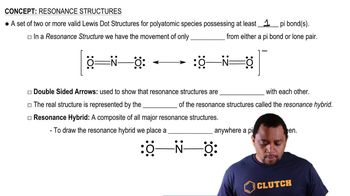
Resonance structures are different ways of drawing the same molecule that illustrate the delocalization of electrons. In the case of the fulminate ion, multiple resonance forms can be drawn, each contributing to the overall electronic structure. The stability of a molecule is often enhanced by resonance, as it allows for the distribution of charge and energy across different structures, which is less favorable in the case of the fulminate ion compared to the cyanate ion.
추천 영상:
가이드 코스
01:42
Resonance Structures

Formal Charge

Formal charge is a theoretical charge assigned to an atom in a molecule, calculated based on the number of valence electrons, the number of bonds, and the number of lone pair electrons. It helps predict the stability of a molecule; lower formal charges on atoms generally indicate greater stability. In the fulminate ion, the presence of higher formal charges on certain atoms compared to the cyanate ion contributes to its instability and increased reactivity.
추천 영상: