Ch.9 - Chemical Bonding I: The Lewis Model
Tro - Chemistry: A Molecular Approach 4th Edition
Tro4th EditionChemistry: A Molecular ApproachISBN: 9780134112831당신이 사용하는 게 아니라요?교과서 변경
9장, 문제 114

A compound composed of only carbon and chlorine is 85.5% chlorine by mass. Propose a Lewis structure for the compound.

검증된 단계별 안내
1
Determine the mass percentage of carbon in the compound by subtracting the mass percentage of chlorine from 100%. This gives you the mass percentage of carbon.
Assume a sample size of 100 grams to simplify calculations. This assumption means that the mass of chlorine in the compound is 85.5 grams and the mass of carbon is the remainder.
Convert the mass of each element to moles by using their respective molar masses. The molar mass of chlorine (Cl) is approximately 35.5 g/mol, and the molar mass of carbon (C) is approximately 12.0 g/mol.
Calculate the simplest whole number ratio of moles of carbon to moles of chlorine in the compound. This ratio will help in determining the empirical formula of the compound.
Use the empirical formula to propose a Lewis structure. Remember that carbon typically forms four bonds in neutral compounds, and chlorine usually forms one bond. Arrange the atoms to satisfy these bonding preferences and to achieve a neutral overall charge.

비슷한 문제에 대한 검증된 영상 답변:

이 영상 해법은 위 문제에 도움이 된다고 튜터들이 추천한 것입니다.

주요 개념

질문에 올바르게 답하기 위해 반드시 이해해야 하는 핵심 개념들은 다음과 같습니다.

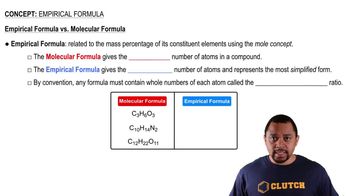
Empirical Formula

The empirical formula represents the simplest whole-number ratio of elements in a compound. In this case, knowing that the compound is 85.5% chlorine by mass allows us to determine the ratio of carbon to chlorine, which is essential for proposing a Lewis structure.
추천 영상:
가이드 코스
02:26
Empirical vs Molecular Formula

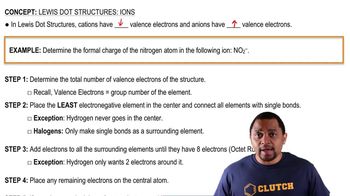
Lewis Structures

Lewis structures are diagrams that represent the bonding between atoms in a molecule and the lone pairs of electrons. They help visualize how atoms are connected and the distribution of electrons, which is crucial for understanding the compound's chemical behavior and stability.
추천 영상:
가이드 코스
04:28
Lewis Dot Structures: Ions

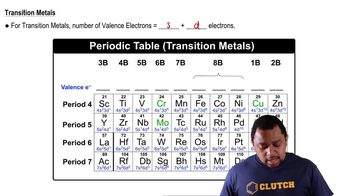
Valence Electrons

Valence electrons are the outermost electrons of an atom and are involved in forming bonds. Knowing the number of valence electrons for carbon and chlorine is vital for accurately drawing the Lewis structure, as it determines how atoms will bond and share electrons.
추천 영상:
가이드 코스
02:12
Transition Metals Valence Electrons