Ch.9 - Chemical Bonding I: The Lewis Model
Tro - Chemistry: A Molecular Approach 4th Edition
Tro4th EditionChemistry: A Molecular ApproachISBN: 9780134112831당신이 사용하는 게 아니라요?교과서 변경
9장, 문제 56

Determine whether the bond between each of the following pairs of atoms would be pure covalent, polar covalent, or ionic: a. C and N b. N and S c. K and F d. N and N.

검증된 단계별 안내
1
Determine the electronegativity of each atom in the pair.
Calculate the difference in electronegativity between the two atoms.
Use the difference to classify the bond: pure covalent (0), polar covalent (0 < difference < 2), or ionic (difference >= 2).
Apply this method to each pair: a. C and N, b. N and S, c. K and F, d. N and N.
Summarize the bond type for each pair based on the calculated differences.

주요 개념

질문에 올바르게 답하기 위해 반드시 이해해야 하는 핵심 개념들은 다음과 같습니다.

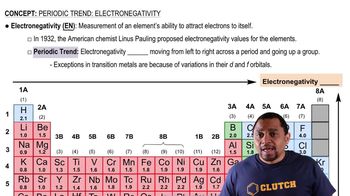
Electronegativity

Electronegativity is a measure of an atom's ability to attract and hold onto electrons in a chemical bond. The difference in electronegativity between two atoms determines the type of bond they will form: a small difference indicates a covalent bond, while a large difference suggests an ionic bond. Understanding electronegativity is crucial for predicting bond characteristics.
추천 영상:
가이드 코스
02:10
Electronegativity Trends

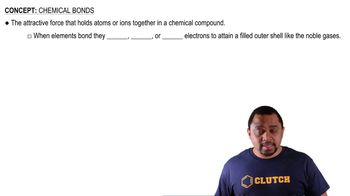
Types of Chemical Bonds

Chemical bonds can be classified into three main types: pure covalent, polar covalent, and ionic. Pure covalent bonds occur between atoms with identical electronegativities, resulting in equal sharing of electrons. Polar covalent bonds form when there is a moderate difference in electronegativity, leading to unequal sharing, while ionic bonds arise from a significant difference, causing one atom to completely transfer electrons to another.
추천 영상:

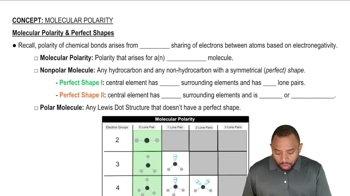
Bond Polarity

Bond polarity refers to the distribution of electrical charge across a bond between two atoms. In polar covalent bonds, the shared electrons are drawn closer to the more electronegative atom, creating a dipole moment. In contrast, pure covalent bonds have no dipole moment due to equal sharing, and ionic bonds result in full charges on the ions, leading to strong electrostatic attractions.
추천 영상:
가이드 코스
02:38
Molecular Polarity