Ch.9 - Chemical Bonding I: The Lewis Model
Tro - Chemistry: A Molecular Approach 4th Edition
Tro4th EditionChemistry: A Molecular ApproachISBN: 9780134112831당신이 사용하는 게 아니라요?교과서 변경
9장, 문제 48

Use the Born–Haber cycle and data from Appendix IIB and Table 9.3 to calculate the lattice energy of CaO. (ΔHsub for calcium is 178 kJ/mol; IE1 and IE2 for calcium are 590 kJ/mol and 1145 kJ/mol, respectively; EA1 and EA2 for O are -141 kJ/mol and 744 kJ/mol, respectively.)

검증된 단계별 안내
1
Identify all the relevant energies provided and required for the Born-Haber cycle: sublimation energy of calcium (ΔHsub), first and second ionization energies of calcium (IE1, IE2), and the first and second electron affinities of oxygen (EA1, EA2).
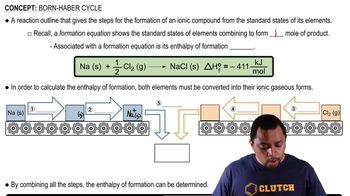
Write the Born-Haber cycle for the formation of CaO. Start with solid calcium and diatomic oxygen gas as reactants, and proceed through the steps of sublimation, ionization, electron affinity, and formation of solid CaO.
Apply Hess's Law to the cycle, which states that the total enthalpy change for a reaction is the sum of all changes and is independent of the pathway taken. Set up an equation where the sum of the enthalpy changes for sublimation, ionization, electron affinity, and formation equals the enthalpy of formation of CaO.
Substitute the given values into the equation. Include the sublimation energy of calcium, the first and second ionization energies of calcium, and the first and second electron affinities of oxygen.
Solve the equation for the lattice energy of CaO, which is the unknown in the cycle. Rearrange the equation to isolate the lattice energy on one side.

비슷한 문제에 대한 검증된 영상 답변:

이 영상 해법은 위 문제에 도움이 된다고 튜터들이 추천한 것입니다.

주요 개념

질문에 올바르게 답하기 위해 반드시 이해해야 하는 핵심 개념들은 다음과 같습니다.

Born-Haber Cycle

The Born-Haber cycle is a thermodynamic cycle that relates the lattice energy of an ionic compound to other thermodynamic quantities. It involves a series of steps, including the sublimation of the metal, ionization energy, electron affinity, and the formation of the ionic solid from its gaseous ions. This cycle allows for the calculation of lattice energy by applying Hess's law, which states that the total enthalpy change is the sum of the changes in each step.
추천 영상:
가이드 코스
03:49
Born Haber Cycle

Lattice Energy

Lattice energy is the energy released when gaseous ions combine to form an ionic solid, or the energy required to separate one mole of an ionic solid into its gaseous ions. It is a measure of the strength of the forces between the ions in an ionic compound. Higher lattice energy indicates stronger ionic bonds, which typically results in higher melting points and greater stability of the compound.
추천 영상:

Ionization Energy and Electron Affinity

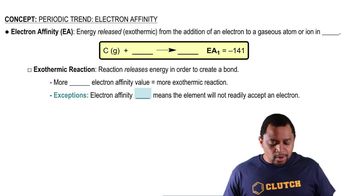
Ionization energy is the energy required to remove an electron from an atom or ion in the gas phase, while electron affinity is the energy change that occurs when an electron is added to a neutral atom in the gas phase. These concepts are crucial in the Born-Haber cycle as they help quantify the energy changes associated with forming cations and anions, which are essential for calculating the overall lattice energy of ionic compounds like CaO.
추천 영상:
가이드 코스
01:34
Electron Affinity