Ch.9 - Chemical Bonding I: The Lewis Model
Tro - Chemistry: A Molecular Approach 4th Edition
Tro4th EditionChemistry: A Molecular ApproachISBN: 9780134112831당신이 사용하는 게 아니라요?교과서 변경
9장, 문제 38

How do you write a Lewis symbol for each of the following atoms or ions? a. S2– b. Mg c. Mg2+ d. P

검증된 단계별 안내
1
Step 1: Understand the concept of Lewis symbols. Lewis symbols represent the valence electrons of an atom or ion. Each dot around the symbol of the element represents one valence electron.
Step 2: Determine the number of valence electrons for each atom or ion. For neutral atoms, this is the same as the group number in the periodic table. For ions, adjust the number of electrons based on the charge.
Step 3: Write the Lewis symbol for S2–. Sulfur (S) is in group 16, so it has 6 valence electrons. As S2–, it gains 2 additional electrons, making a total of 8 valence electrons. Represent this with 8 dots around the symbol 'S'.
Step 4: Write the Lewis symbol for Mg. Magnesium (Mg) is in group 2, so it has 2 valence electrons. Represent this with 2 dots around the symbol 'Mg'.
Step 5: Write the Lewis symbol for Mg2+ and P. For Mg2+, it loses 2 electrons, resulting in no valence electrons, so the symbol 'Mg' has no dots. For phosphorus (P), which is in group 15, it has 5 valence electrons, represented by 5 dots around the symbol 'P'.

주요 개념

질문에 올바르게 답하기 위해 반드시 이해해야 하는 핵심 개념들은 다음과 같습니다.

Lewis Symbols

Lewis symbols, also known as Lewis dot diagrams, represent the valence electrons of an atom or ion. Each dot corresponds to a valence electron, and the arrangement of these dots around the chemical symbol indicates how the atom can bond with others. Understanding Lewis symbols is essential for visualizing electron sharing and transfer in chemical bonding.
추천 영상:
가이드 코스
00:52
Lewis Dot Symbols

Valence Electrons

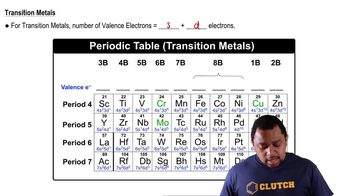
Valence electrons are the outermost electrons of an atom and play a crucial role in chemical bonding. The number of valence electrons determines an atom's reactivity and the types of bonds it can form. For example, sulfur (S) has six valence electrons, while magnesium (Mg) has two, which influences how they interact with other elements.
추천 영상:
가이드 코스
02:12
Transition Metals Valence Electrons

Ionic Charge

Ionic charge refers to the electrical charge an atom or ion carries due to the loss or gain of electrons. For instance, a magnesium ion (Mg2+) has lost two electrons, resulting in a positive charge, while a sulfide ion (S2–) has gained two electrons, leading to a negative charge. Understanding ionic charges is vital for accurately representing ions in Lewis symbols.
추천 영상: