Ch.10 - Chemical Bonding I: The Lewis Model
Tro - Chemistry: A Molecular Approach 5th Edition
Tro5th EditionChemistry: A Molecular ApproachISBN: 9780134874371당신이 사용하는 게 아니라요?교과서 변경
10장, 문제 97

The cyanate ion (OCN- ) and the fulminate ion (CNO- ) share the same three atoms but have vastly different properties. The cyanate ion is stable, while the fulminate ion is unstable and forms explosive compounds. The resonance structures of the cyanate ion are explored in Example 10.8. Draw Lewis structures for the fulminate ion—including possible resonance forms— and use formal charge to explain why the fulminate ion is less stable (and therefore more reactive) than the cyanate ion.

검증된 단계별 안내
1
Draw the basic Lewis structure for the fulminate ion (CNO^-). Start by arranging the atoms in a linear fashion: C-N-O.
Count the total number of valence electrons available. Carbon has 4, nitrogen has 5, and oxygen has 6. Since the ion has a -1 charge, add one more electron, giving a total of 16 valence electrons.
Distribute the electrons to satisfy the octet rule for each atom, starting with the most electronegative atom, oxygen.
Consider possible resonance structures by moving electrons to form double or triple bonds between the atoms, ensuring that the total number of electrons remains constant.
Calculate the formal charge for each atom in each resonance structure using the formula: Formal Charge = (Valence electrons) - (Non-bonding electrons) - 0.5*(Bonding electrons). Compare the formal charges to determine which resonance structure is most stable, and explain why the fulminate ion is less stable than the cyanate ion based on these charges.

비슷한 문제에 대한 검증된 영상 답변:

이 영상 해법은 위 문제에 도움이 된다고 튜터들이 추천한 것입니다.
영상 길이:
12m
도움이 되었나요?

주요 개념

질문에 올바르게 답하기 위해 반드시 이해해야 하는 핵심 개념들은 다음과 같습니다.

Lewis Structures

Lewis structures are diagrams that represent the bonding between atoms in a molecule and the lone pairs of electrons that may exist. They help visualize the arrangement of electrons and the connectivity of atoms, which is crucial for understanding molecular stability and reactivity. By drawing Lewis structures, one can identify the formal charges on atoms, which play a significant role in determining the stability of ions like the fulminate and cyanate.
추천 영상:
가이드 코스
04:28
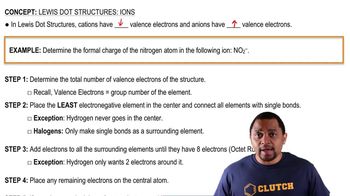
Lewis Dot Structures: Ions

Resonance Structures

Resonance structures are different ways of drawing the same molecule that illustrate the delocalization of electrons. In the case of the fulminate ion, multiple resonance forms can be drawn, each contributing to the overall hybrid structure. Understanding resonance is essential for explaining the stability of ions, as it allows for the distribution of charge and electron density, which can affect reactivity and stability.
추천 영상:
가이드 코스
01:42
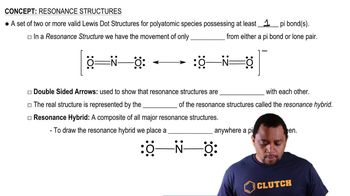
Resonance Structures

Formal Charge

Formal charge is a theoretical charge assigned to an atom in a molecule, calculated based on the number of valence electrons, the number of bonds, and the number of lone pair electrons. It helps assess the stability of a molecule or ion by indicating how charge is distributed among atoms. In comparing the fulminate and cyanate ions, analyzing formal charges can reveal why the fulminate ion is less stable, as higher formal charges often correlate with increased reactivity.
추천 영상: