Carbon ring structures are common in organic chemistry. Draw a Lewis structure for each carbon ring structure, including any necessary resonance structures. a. C4H8 b. C4H4 c. C6H12 d. C6H6
Ch.10 - Chemical Bonding I: The Lewis Model
10장, 문제 87b,c,d
Each compound contains both ionic and covalent bonds. Write ionic Lewis structures for each, including the covalent structure for the ion in brackets. Write resonance structures if necessary. b. Ca(OH)2 c. KNO3 d. LiIO
검증된 단계별 안내1
Identify the ions present in KNO_3. Potassium (K) forms a cation (K^+) and the nitrate ion (NO_3^-) is the anion.
Draw the Lewis structure for the potassium ion (K^+), which is simply K with a positive charge, as it loses one electron.
For the nitrate ion (NO_3^-), start by counting the total number of valence electrons. Nitrogen has 5, each oxygen has 6, and there is an extra electron due to the negative charge, totaling 24 electrons.
Draw the covalent structure for NO_3^-. Place nitrogen in the center, single bond it to each oxygen, and distribute the remaining electrons to satisfy the octet rule. Use double bonds where necessary to minimize formal charges.
Consider resonance structures for NO_3^-. The double bond can be placed between nitrogen and any of the three oxygens, resulting in three equivalent resonance structures. Enclose the nitrate ion structure in brackets with a negative charge outside.

비슷한 문제에 대한 검증된 영상 답변:
이 영상 해법은 위 문제에 도움이 된다고 튜터들이 추천한 것입니다.
영상 길이:
3m도움이 되었나요?
주요 개념
질문에 올바르게 답하기 위해 반드시 이해해야 하는 핵심 개념들은 다음과 같습니다.
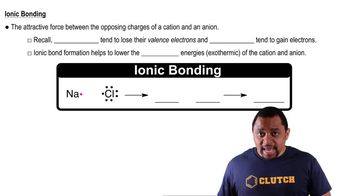
Ionic Bonds
Ionic bonds are formed through the electrostatic attraction between positively and negatively charged ions. In compounds like KNO3, potassium (K) donates an electron to become K+, while the nitrate ion (NO3-) is formed when nitrogen and oxygen atoms share electrons covalently. Understanding ionic bonds is crucial for drawing accurate Lewis structures, as it helps identify the charge distribution in the compound.
추천 영상:
가이드 코스
Chemical Bonds
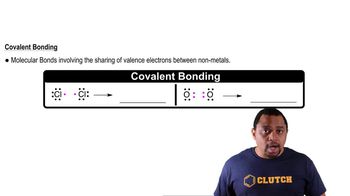
Covalent Bonds
Covalent bonds occur when two atoms share one or more pairs of electrons, allowing them to achieve a full outer electron shell. In the case of the nitrate ion (NO3-), covalent bonding occurs between nitrogen and oxygen atoms, resulting in a stable structure. Recognizing covalent bonds is essential for constructing Lewis structures, as it determines how atoms are connected within the ion.
추천 영상:
가이드 코스
Chemical Bonds
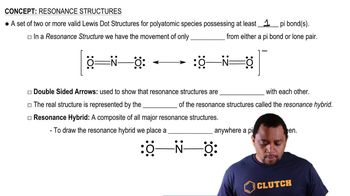
Resonance Structures
Resonance structures are different ways of drawing the same molecule that illustrate the delocalization of electrons. For the nitrate ion (NO3-), resonance structures show that the double bond between nitrogen and one of the oxygen atoms can be represented in multiple ways, reflecting the equal distribution of electron density. This concept is important for accurately depicting the stability and reactivity of the ion in Lewis structures.
추천 영상:
가이드 코스
Resonance Structures
관련 실천
교과서 질문
1248
views
교과서 질문
Write an appropriate Lewis structure for each compound. Make certain to distinguish between ionic and molecular compounds. b. ClF5
586
views
교과서 질문
Amino acids are the building blocks of proteins. The simplest amino acid is glycine (H2NCH2COOH). Draw a Lewis structure for glycine. (Hint: The central atoms in the skeletal structure are nitrogen and the two carbon atoms. Each oxygen atom is bonded directly to the right-most carbon atom.)
1352
views
교과서 질문
Each compound contains both ionic and covalent bonds. Write ionic Lewis structures for each, including the covalent structure for the ion in brackets. Write resonance structures if necessary. a. BaCO3
517
views