Ch.10 - Chemical Bonding I: The Lewis Model
Tro - Chemistry: A Molecular Approach 5th Edition
Tro5th EditionChemistry: A Molecular ApproachISBN: 9780134874371당신이 사용하는 게 아니라요?교과서 변경
10장, 문제 64

Write a Lewis structure that obeys the octet rule for each ion. Include resonance structures if necessary and assign formal charges to each atom. a. ClO3- b. ClO4- c. NO3- d. NH4+

검증된 단계별 안내
1
Identify the total number of valence electrons for each ion. For example, for ClO3-, count the valence electrons from Cl and O atoms, and add one extra electron for the negative charge.
Draw a skeletal structure for each ion, connecting the central atom to surrounding atoms with single bonds. Typically, the least electronegative atom is the central atom.
Distribute the remaining valence electrons as lone pairs to complete the octet for the surrounding atoms first, then place any remaining electrons on the central atom.
If the central atom does not have a complete octet, consider forming double or triple bonds by converting lone pairs from surrounding atoms into bonding pairs.
Check for resonance structures by moving electrons around to see if different valid structures can be formed. Assign formal charges to each atom using the formula: Formal Charge = (Valence electrons) - (Non-bonding electrons) - 0.5*(Bonding electrons).

비슷한 문제에 대한 검증된 영상 답변:

이 영상 해법은 위 문제에 도움이 된다고 튜터들이 추천한 것입니다.
영상 길이:
1m
도움이 되었나요?

주요 개념

질문에 올바르게 답하기 위해 반드시 이해해야 하는 핵심 개념들은 다음과 같습니다.

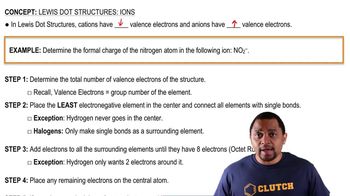
Lewis Structures

Lewis structures are diagrams that represent the bonding between atoms in a molecule and the lone pairs of electrons that may exist. They are essential for visualizing the arrangement of electrons and understanding molecular geometry. In these structures, dots represent valence electrons, and lines represent covalent bonds. Drawing Lewis structures helps predict the stability and reactivity of molecules.
추천 영상:
가이드 코스
04:28
Lewis Dot Structures: Ions

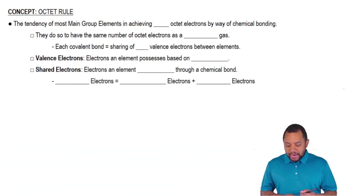
Octet Rule

The octet rule is a chemical guideline stating that atoms tend to bond in such a way that they each have eight electrons in their valence shell, achieving a stable electron configuration similar to that of noble gases. This rule is particularly applicable to main group elements and helps in predicting the formation of ions and molecules. However, there are exceptions, especially for elements in the third period and beyond, which can accommodate more than eight electrons.
추천 영상:

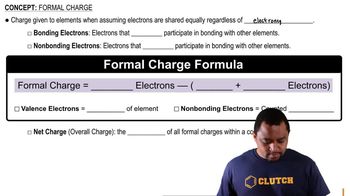
Formal Charge

Formal charge is a concept used to determine the charge distribution within a molecule or ion, calculated by comparing the number of valence electrons in the free atom to the number of electrons assigned to it in the Lewis structure. It helps assess the stability of a structure; ideally, the formal charges should be minimized, and the most stable structures have formal charges close to zero. Assigning formal charges is crucial when evaluating resonance structures and determining the most favorable Lewis structure.
추천 영상: