Ch.11 - Chemical Bonding II: Molecular Shapes, VSEPR & MO Theory
Tro - Chemistry: A Molecular Approach 5th Edition
Tro5th EditionChemistry: A Molecular ApproachISBN: 9780134874371당신이 사용하는 게 아니라요?교과서 변경
11장, 문제 63d

Write a hybridization and bonding scheme for each molecule or ion. Sketch the structure, including overlapping orbitals, and label all bonds using the notation shown in Examples 11.6 and 11.7. d. I3–

검증된 단계별 안내
1
Identify the central atom in the I3^- ion, which is iodine (I).
Determine the total number of valence electrons in the I3^- ion. Iodine has 7 valence electrons, and there are three iodine atoms plus one extra electron due to the negative charge, giving a total of 22 valence electrons.
Arrange the atoms in a linear geometry with the central iodine atom bonded to the two outer iodine atoms. Distribute the remaining electrons to satisfy the octet rule, placing lone pairs on the central iodine atom.
Determine the hybridization of the central iodine atom. Since there are 3 lone pairs and 2 bonding pairs, the hybridization is sp^3d, which accommodates 5 electron domains.
Sketch the structure showing the linear arrangement of the I3^- ion, with the central iodine atom using sp^3d hybrid orbitals to form sigma bonds with the outer iodine atoms. Label the bonds as sigma (σ) bonds and indicate the lone pairs on the central iodine atom.

비슷한 문제에 대한 검증된 영상 답변:

이 영상 해법은 위 문제에 도움이 된다고 튜터들이 추천한 것입니다.
영상 길이:
11m
도움이 되었나요?

주요 개념

질문에 올바르게 답하기 위해 반드시 이해해야 하는 핵심 개념들은 다음과 같습니다.

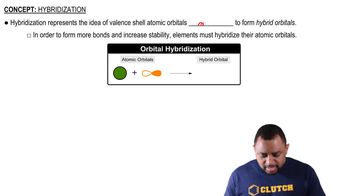
Hybridization

Hybridization is the process of combining atomic orbitals to form new hybrid orbitals that are suitable for the pairing of electrons to form chemical bonds. In the case of I3–, the central iodine atom undergoes sp3 hybridization, which allows it to form bonds with the surrounding iodine atoms while accommodating lone pairs of electrons.
추천 영상:

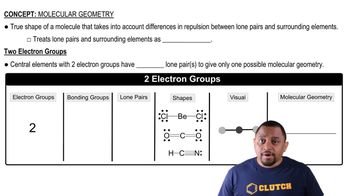
Bonding and Molecular Geometry

Bonding refers to the interactions between atoms that lead to the formation of molecules. The molecular geometry of I3– can be determined using the VSEPR theory, which predicts that the arrangement of electron pairs around the central atom will minimize repulsion, resulting in a linear shape due to the presence of three bonding pairs and two lone pairs.
추천 영상:
가이드 코스
01:33
Molecular Geometry with Two Electron Groups

Orbital Overlap

Orbital overlap is a key concept in understanding how atoms bond together. It occurs when atomic orbitals from different atoms come close enough to allow their electron clouds to interact, leading to the formation of covalent bonds. In I3–, the overlap of the hybridized orbitals of iodine atoms facilitates the formation of sigma bonds, while any remaining p orbitals can participate in pi bonding if applicable.
추천 영상:
가이드 코스
03:06
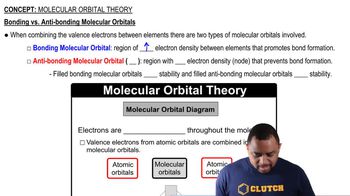
Molecular Orbital Theory