Determine the electron geometry, molecular geometry, and idealized bond angles for each molecule. In which cases do you expect deviations from the idealized bond angle? a. PF3 b. SBr2 c. CHCl3 d. CS2
Ch.11 - Chemical Bonding II: Molecular Shapes, VSEPR & MO Theory
11장, 문제 36
Determine the electron geometry, molecular geometry, and idealized bond angles for each molecule. In which cases do you expect deviations from the idealized bond angle? a. CF4 b. NF3 c. OF2 d. H2S
검증된 단계별 안내1
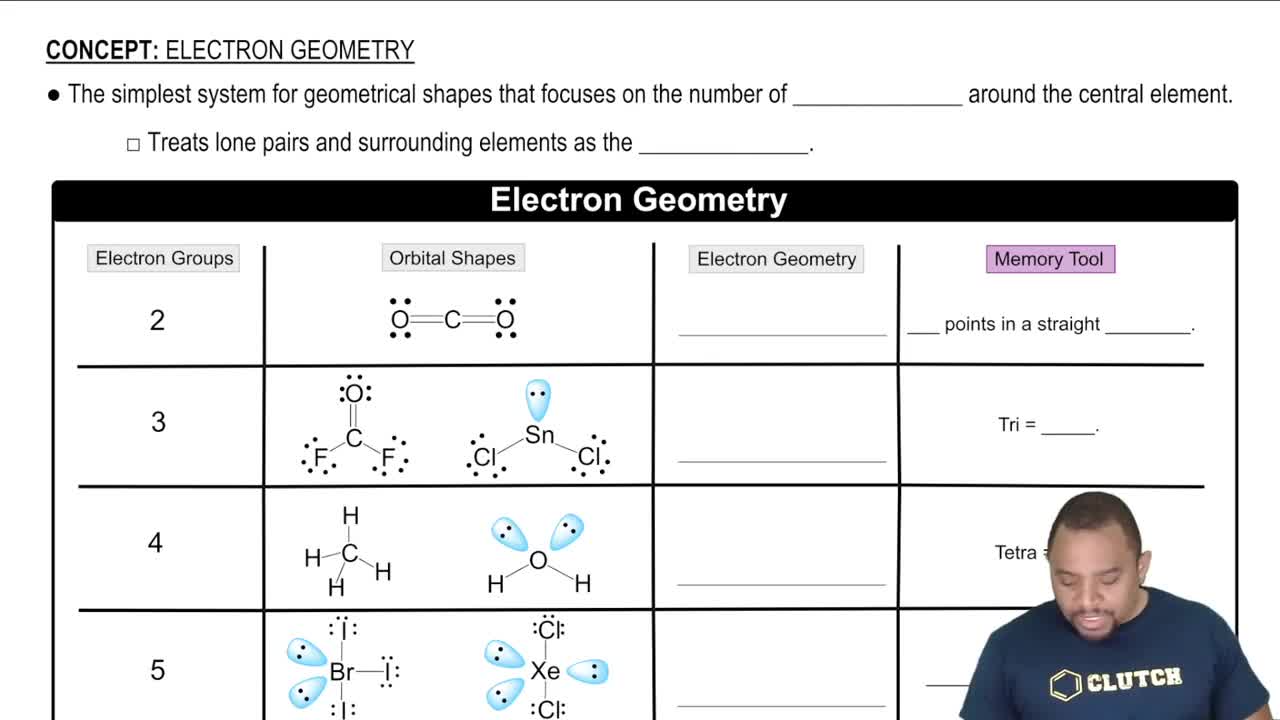
Determine the electron geometry for each molecule using VSEPR theory.
Determine the molecular geometry for each molecule based on the electron geometry and the number of lone pairs.
Identify the idealized bond angles for each molecular geometry.
Consider the presence of lone pairs and their effect on bond angles to identify any deviations from the idealized bond angles.
Summarize the electron geometry, molecular geometry, idealized bond angles, and any expected deviations for each molecule.

비슷한 문제에 대한 검증된 영상 답변:
이 영상 해법은 위 문제에 도움이 된다고 튜터들이 추천한 것입니다.
영상 길이:
2m도움이 되었나요?
주요 개념
질문에 올바르게 답하기 위해 반드시 이해해야 하는 핵심 개념들은 다음과 같습니다.
Electron Geometry
Electron geometry refers to the spatial arrangement of all electron groups (bonding and lone pairs) around a central atom. It is determined using the VSEPR (Valence Shell Electron Pair Repulsion) theory, which states that electron groups will arrange themselves to minimize repulsion. Common geometries include linear, trigonal planar, tetrahedral, and octahedral, each associated with specific numbers of electron groups.
추천 영상:
가이드 코스
Electron Geometry
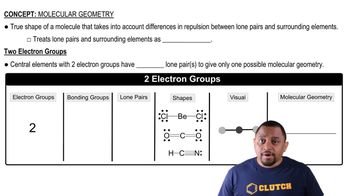
Molecular Geometry
Molecular geometry describes the three-dimensional arrangement of atoms in a molecule, considering only the positions of the nuclei of the atoms. While electron geometry includes lone pairs, molecular geometry focuses on the shape formed by the atoms themselves. For example, a molecule may have a tetrahedral electron geometry but a trigonal pyramidal molecular geometry if it has one lone pair.
추천 영상:
가이드 코스
Molecular Geometry with Two Electron Groups
Idealized Bond Angles and Deviations
Idealized bond angles are the angles between adjacent bonds in a molecule, predicted by the electron geometry. For instance, in a tetrahedral arrangement, the ideal bond angle is 109.5 degrees. Deviations from these angles can occur due to factors such as lone pair repulsion, differences in electronegativity, or steric hindrance, which can alter the spatial arrangement of atoms and affect bond angles.
추천 영상:
가이드 코스
Ideal Bond Angle Example
관련 실천
교과서 질문
1624
views
1
comments
교과서 질문
A molecule with the formula AB3 has a trigonal planar geometry. How many electron groups are on the central atom?
966
views
교과서 질문
Determine the molecular geometry and sketch each molecule or ion using the bond conventions shown in 'Representing Molecular Geometries on Paper' in Section 10.4. c. IF2-
469
views
교과서 질문
Which species has the smaller bond angle, ClO4- or ClO3- ? Explain.
998
views
교과서 질문
Which species has the smaller bond angle, H3O+ or H2O? Explain.
1068
views
교과서 질문
For each molecular geometry, list the number of total electron groups, the number of bonding groups, and the number of lone pairs on the central atom. (c)
1241
views