Ch.11 - Chemical Bonding II: Molecular Shapes, VSEPR & MO Theory
Tro - Chemistry: A Molecular Approach 5th Edition
Tro5th EditionChemistry: A Molecular ApproachISBN: 9780134874371당신이 사용하는 게 아니라요?교과서 변경
11장, 문제 75d

Using the molecular orbital energy ordering for second-row homonuclear diatomic molecules in which the π2p orbitals lie at lower energy than the σ2p, draw MO energy diagrams and predict the bond order in a molecule or ion with each number of total valence electrons. Will the molecule or ion be diamagnetic or paramagnetic?? b. 6 d. 9

검증된 단계별 안내
1
Identify the total number of valence electrons in the molecule or ion. In this case, it is given as 9.
Construct the molecular orbital (MO) diagram for second-row homonuclear diatomic molecules, noting that the \( \pi_{2p} \) orbitals are lower in energy than the \( \sigma_{2p} \) orbital.
Fill the molecular orbitals with the 9 valence electrons, starting from the lowest energy level and following Hund's rule and the Pauli exclusion principle.
Calculate the bond order using the formula: \( \text{Bond Order} = \frac{(\text{Number of electrons in bonding MOs} - \text{Number of electrons in antibonding MOs})}{2} \).
Determine if the molecule or ion is diamagnetic or paramagnetic by checking if all electrons are paired (diamagnetic) or if there are unpaired electrons (paramagnetic).

비슷한 문제에 대한 검증된 영상 답변:

이 영상 해법은 위 문제에 도움이 된다고 튜터들이 추천한 것입니다.
영상 길이:
5m
도움이 되었나요?

주요 개념

질문에 올바르게 답하기 위해 반드시 이해해야 하는 핵심 개념들은 다음과 같습니다.

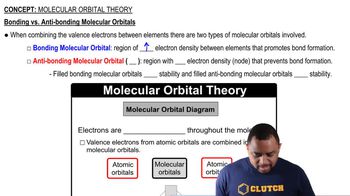
Molecular Orbital Theory

Molecular Orbital Theory describes how atomic orbitals combine to form molecular orbitals, which can be occupied by electrons. In diatomic molecules, these orbitals are arranged in energy levels, and their occupancy determines the molecule's properties, including bond order and magnetic behavior. Understanding the energy ordering of these orbitals is crucial for predicting the stability and characteristics of the molecule.
추천 영상:
가이드 코스
03:06
Molecular Orbital Theory

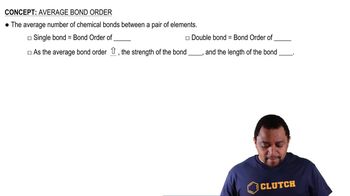
Bond Order

Bond order is a measure of the number of chemical bonds between a pair of atoms, calculated as the difference between the number of bonding and antibonding electrons divided by two. A higher bond order indicates a stronger bond and greater stability of the molecule. For example, a bond order of 1 corresponds to a single bond, while a bond order of 2 indicates a double bond.
추천 영상:
가이드 코스
00:36
Average Bond Order

Magnetism in Molecules

The magnetic properties of a molecule, whether it is diamagnetic or paramagnetic, depend on the presence of unpaired electrons in its molecular orbitals. Diamagnetic molecules have all electrons paired and are not attracted to a magnetic field, while paramagnetic molecules contain unpaired electrons and are attracted to magnetic fields. This distinction is essential for predicting the behavior of the molecule in external magnetic fields.
추천 영상:
가이드 코스
00:59
Magnetic Quantum Example
관련 실천
교과서 질문

Using the molecular orbital energy ordering for second-row homonuclear diatomic molecules in which the π2p orbitals lie at lower energy than the σ2p, draw MO energy diagrams and predict the bond order in a molecule or ion with each number of total valence electrons. Will the molecule or ion be diamagnetic or paramagnetic? a. 4 b. 6

332
views
교과서 질문

Using the molecular orbital energy ordering for second-row homonuclear diatomic molecules in which the π2p orbitals lie at higher energy than the σ2p, draw MO energy diagrams and predict the bond order in a molecule or ion with each number of total valence electrons. Will the molecule or ion be diamagnetic or paramagnetic? c. 13

1821
views
교과서 질문

Sketch the bonding and antibonding molecular orbitals that result from linear combinations of the 2pz atomic orbitals in a homonuclear diatomic molecule. (The 2pz orbitals are those whose lobes are oriented perpendicular to the bonding axis.) How do these molecular orbitals differ from those obtained from linear combinations of the 2py atomic orbitals? (The 2py orbitals are also oriented perpendicular to the bonding axis, but also perpendicular to the 2pz orbitals.)

817
views
교과서 질문

Using the molecular orbital energy ordering for second-row homonuclear diatomic molecules in which the π2p orbitals lie at higher energy than the σ2p, draw MO energy diagrams and predict the bond order in a molecule or ion with each number of total valence electrons. Will the molecule or ion be diamagnetic or paramagnetic? a. 10

459
views
교과서 질문

Using the molecular orbital energy ordering for second-row homonuclear diatomic molecules in which the π2p orbitals lie at lower energy than the σ2p, draw MO energy diagrams and predict the bond order in a molecule or ion with each number of total valence electrons. Will the molecule or ion be diamagnetic or paramagnetic? c. 8

505
views