Nitrogen has a normal boiling point of 77.3 K and a melting point (at 1 atm) of 63.1 K. Its critical temperature is 126.2 K and its critical pressure is 2.55×10⁴ torr. It has a triple point at 63.1 K and 94.0 torr. Sketch the phase diagram for nitrogen. Does nitrogen have a stable liquid state at 1 atm?
Ch.12 - Liquids, Solids & Intermolecular Forces
12장, 문제 70
How much ice (in grams) would have to melt to lower the temperature of 352 mL of water from 25 °C to 5 °C? (Assume the density of water is 1.0 g/mL.)
검증된 단계별 안내1
Calculate the mass of the water using the formula: \( \text{mass} = \text{volume} \times \text{density} \). Since the density of water is 1.0 g/mL, the mass of 352 mL of water is 352 g.
Determine the amount of heat lost by the water as it cools from 25 °C to 5 °C using the formula: \( q = m \cdot c \cdot \Delta T \), where \( m \) is the mass of the water, \( c \) is the specific heat capacity of water (4.18 J/g°C), and \( \Delta T \) is the change in temperature.
Calculate \( \Delta T \) as the difference between the initial and final temperatures: \( \Delta T = 5 \text{ °C} - 25 \text{ °C} = -20 \text{ °C} \).
Use the heat lost by the water to determine the mass of ice that must melt. The heat absorbed by the ice is given by \( q = m_{\text{ice}} \cdot \Delta H_f \), where \( \Delta H_f \) is the heat of fusion of ice (334 J/g).
Set the heat lost by the water equal to the heat gained by the ice and solve for \( m_{\text{ice}} \): \( m \cdot c \cdot \Delta T = m_{\text{ice}} \cdot \Delta H_f \).

비슷한 문제에 대한 검증된 영상 답변:
이 영상 해법은 위 문제에 도움이 된다고 튜터들이 추천한 것입니다.
영상 길이:
6m주요 개념
질문에 올바르게 답하기 위해 반드시 이해해야 하는 핵심 개념들은 다음과 같습니다.
Heat Transfer
Heat transfer is the process of thermal energy moving from one object or substance to another due to a temperature difference. In this scenario, the heat lost by the water as it cools from 25 °C to 5 °C will be equal to the heat gained by the ice as it melts. Understanding this concept is crucial for calculating the amount of ice needed to absorb the heat released by the water.
추천 영상:
가이드 코스
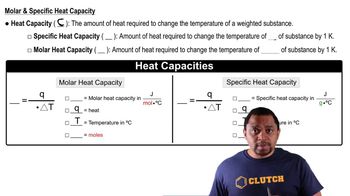
Heat Capacity
Specific Heat Capacity
Specific heat capacity is the amount of heat required to raise the temperature of a unit mass of a substance by one degree Celsius. For water, the specific heat capacity is approximately 4.18 J/g°C. This concept is essential for determining how much energy is released by the water as it cools, which will help in calculating the mass of ice needed to absorb that energy.
추천 영상:
가이드 코스
Heat Capacity
Latent Heat of Fusion
Latent heat of fusion is the amount of heat energy required to change a substance from solid to liquid at its melting point without changing its temperature. For ice, this value is about 334 J/g. This concept is vital for understanding how much energy is needed to melt the ice, which will be compared to the energy lost by the water to find the required mass of ice.
추천 영상:
가이드 코스
Heat Capacity
관련 실천
교과서 질문
2550
views
교과서 질문
An 8.5-g ice cube is placed into 255 g of water. Calculate the temperature change in the water upon the complete melting of the ice. Assume that all of the energy required to melt the ice comes from the water.
3326
views
교과서 질문
Consider the phase diagram shown here. Identify the states present at points a through g.
1221
views
교과서 질문
How much energy is released when 65.8 g of water freezes?
1819
views
2
rank
교과서 질문
Calculate the amount of heat required to completely sublime 50.0 g of solid dry ice (CO2) at its sublimation temperature. The heat of sublimation for carbon dioxide is 32.3 kJ/mol.
6136
views
5
rank
