Ch.12 - Liquids, Solids & Intermolecular Forces
Tro - Chemistry: A Molecular Approach 5th Edition
Tro5th EditionChemistry: A Molecular ApproachISBN: 9780134874371당신이 사용하는 게 아니라요?교과서 변경
12장, 문제 43

In each pair of compounds, pick the one with the higher vapor pressure at a given temperature. Explain your reasoning. a. Br2 or I2 b. H2S or H2O c. NH3 or PH3

검증된 단계별 안내
1
Step 1: Understand that vapor pressure is the pressure exerted by a vapor in equilibrium with its liquid or solid phase. It is influenced by intermolecular forces; weaker forces result in higher vapor pressure.
Step 2: For part (a), compare Br_2 and I_2. Both are halogens and nonpolar molecules, but Br_2 has weaker London dispersion forces than I_2 due to its smaller size and lower molar mass, leading to higher vapor pressure.
Step 3: For part (b), compare H_2S and H_2O. H_2O has strong hydrogen bonding due to its highly polar O-H bonds, while H_2S has weaker dipole-dipole interactions. Therefore, H_2S has a higher vapor pressure.
Step 4: For part (c), compare NH_3 and PH_3. NH_3 can form hydrogen bonds due to the presence of N-H bonds, whereas PH_3 cannot form hydrogen bonds and has weaker van der Waals forces, resulting in higher vapor pressure for PH_3.
Step 5: Summarize that the compound with weaker intermolecular forces in each pair will have the higher vapor pressure at a given temperature.

주요 개념

질문에 올바르게 답하기 위해 반드시 이해해야 하는 핵심 개념들은 다음과 같습니다.

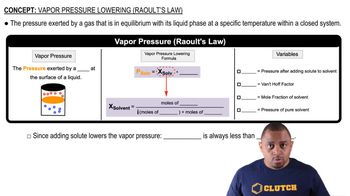
Vapor Pressure

Vapor pressure is the pressure exerted by a vapor in equilibrium with its liquid or solid phase at a given temperature. It reflects the tendency of molecules to escape from the liquid or solid state into the gas phase. Compounds with weaker intermolecular forces generally have higher vapor pressures because their molecules can more easily enter the vapor phase.
추천 영상:
가이드 코스
02:40
Raoult's Law and Vapor Pressure

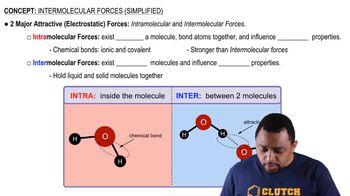
Intermolecular Forces

Intermolecular forces are the forces of attraction or repulsion between neighboring particles (atoms, molecules, or ions). These forces include hydrogen bonding, dipole-dipole interactions, and London dispersion forces. The strength of these forces significantly influences a substance's boiling point and vapor pressure; weaker forces lead to higher vapor pressures.
추천 영상:
가이드 코스
01:59
Intermolecular vs Intramolecular Forces

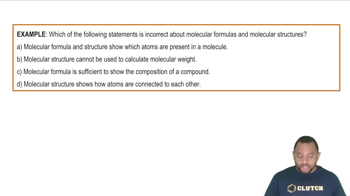
Molecular Weight and Structure

Molecular weight and structure play a crucial role in determining the physical properties of compounds, including vapor pressure. Generally, larger molecules with higher molecular weights exhibit stronger London dispersion forces, which can lower vapor pressure. Additionally, the presence of polar bonds and functional groups can affect intermolecular interactions, influencing vapor pressure as well.
추천 영상:
가이드 코스
01:09
Structural Formula Example