Ch.12 - Liquids, Solids & Intermolecular Forces
Tro - Chemistry: A Molecular Approach 5th Edition
Tro5th EditionChemistry: A Molecular ApproachISBN: 9780134874371당신이 사용하는 게 아니라요?교과서 변경
12장, 문제 61

This table displays the vapor pressure of ammonia at several different temperatures. Use the data to determine the heat of vaporization and normal boiling point of ammonia.
Temperature (K) Pressure (torr)
200 65.3
210 134.3
220 255.7
230 456.0
235 597.0

검증된 단계별 안내
1
insert step 1: Use the Clausius-Clapeyron equation, which relates the vapor pressure and temperature of a substance to its heat of vaporization: \( \ln P = -\frac{\Delta H_{vap}}{R} \left( \frac{1}{T} \right) + C \), where \( P \) is the vapor pressure, \( T \) is the temperature in Kelvin, \( \Delta H_{vap} \) is the heat of vaporization, \( R \) is the ideal gas constant (8.314 J/mol·K), and \( C \) is a constant.
insert step 2: Convert the given pressures from torr to atm if necessary, or use them directly in the equation as long as the units are consistent.
insert step 3: Plot \( \ln P \) versus \( \frac{1}{T} \) using the given data points. The slope of the resulting line will be \( -\frac{\Delta H_{vap}}{R} \).
insert step 4: Calculate the slope of the line from the plot. Use the slope to determine \( \Delta H_{vap} \) by rearranging the equation to \( \Delta H_{vap} = -\text{slope} \times R \).
insert step 5: To find the normal boiling point, set the vapor pressure \( P \) equal to 760 torr (1 atm) in the Clausius-Clapeyron equation and solve for the temperature \( T \).

비슷한 문제에 대한 검증된 영상 답변:

이 영상 해법은 위 문제에 도움이 된다고 튜터들이 추천한 것입니다.
영상 길이:
13m
도움이 되었나요?

주요 개념

질문에 올바르게 답하기 위해 반드시 이해해야 하는 핵심 개념들은 다음과 같습니다.

Vapor Pressure

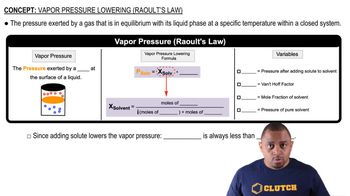
Vapor pressure is the pressure exerted by a vapor in equilibrium with its liquid or solid phase at a given temperature. It reflects the tendency of particles to escape from the liquid phase into the vapor phase. Understanding vapor pressure is crucial for determining the boiling point of a substance, as the boiling point is reached when the vapor pressure equals the external pressure.
추천 영상:
가이드 코스
02:40
Raoult's Law and Vapor Pressure

Heat of Vaporization

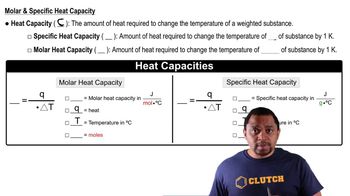
The heat of vaporization is the amount of energy required to convert a unit mass of a liquid into vapor without a change in temperature. This concept is essential for calculating the energy needed for phase changes and is typically expressed in joules per mole. The heat of vaporization can be derived from the Clausius-Clapeyron equation, which relates vapor pressure and temperature.
추천 영상:

Clausius-Clapeyron Equation

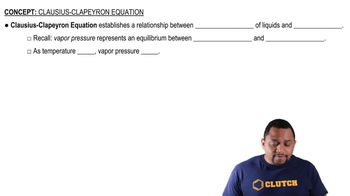
The Clausius-Clapeyron equation describes the relationship between vapor pressure and temperature for a substance. It can be used to calculate the heat of vaporization by plotting the natural logarithm of vapor pressure against the inverse of temperature. This equation is fundamental in thermodynamics and helps in understanding phase transitions and the behavior of substances under varying conditions.
추천 영상:
가이드 코스
00:59
Clausius-Clapeyron Equation