Ch.12 - Liquids, Solids & Intermolecular Forces
Tro - Chemistry: A Molecular Approach 5th Edition
Tro5th EditionChemistry: A Molecular ApproachISBN: 9780134874371당신이 사용하는 게 아니라요?교과서 변경
12장, 문제 48

Why does water wet some surfaces and bead up on others, while mercury beads up on almost all surfaces?

검증된 단계별 안내
1
Understand the concept of surface tension and how it relates to the cohesive and adhesive forces between molecules.
Recognize that water has strong hydrogen bonds, which contribute to its high surface tension, allowing it to wet surfaces where adhesive forces are stronger than cohesive forces.
Identify that mercury has metallic bonds, which are much stronger than the adhesive forces with most surfaces, leading to high cohesion and causing it to bead up.
Consider the role of surface energy: surfaces with high surface energy (like glass) are more likely to be wetted by water, while low surface energy surfaces (like wax) cause water to bead up.
Apply the concept of contact angle: a low contact angle indicates wetting (water spreads out), while a high contact angle indicates beading (water forms droplets).

주요 개념

질문에 올바르게 답하기 위해 반드시 이해해야 하는 핵심 개념들은 다음과 같습니다.

Surface Tension

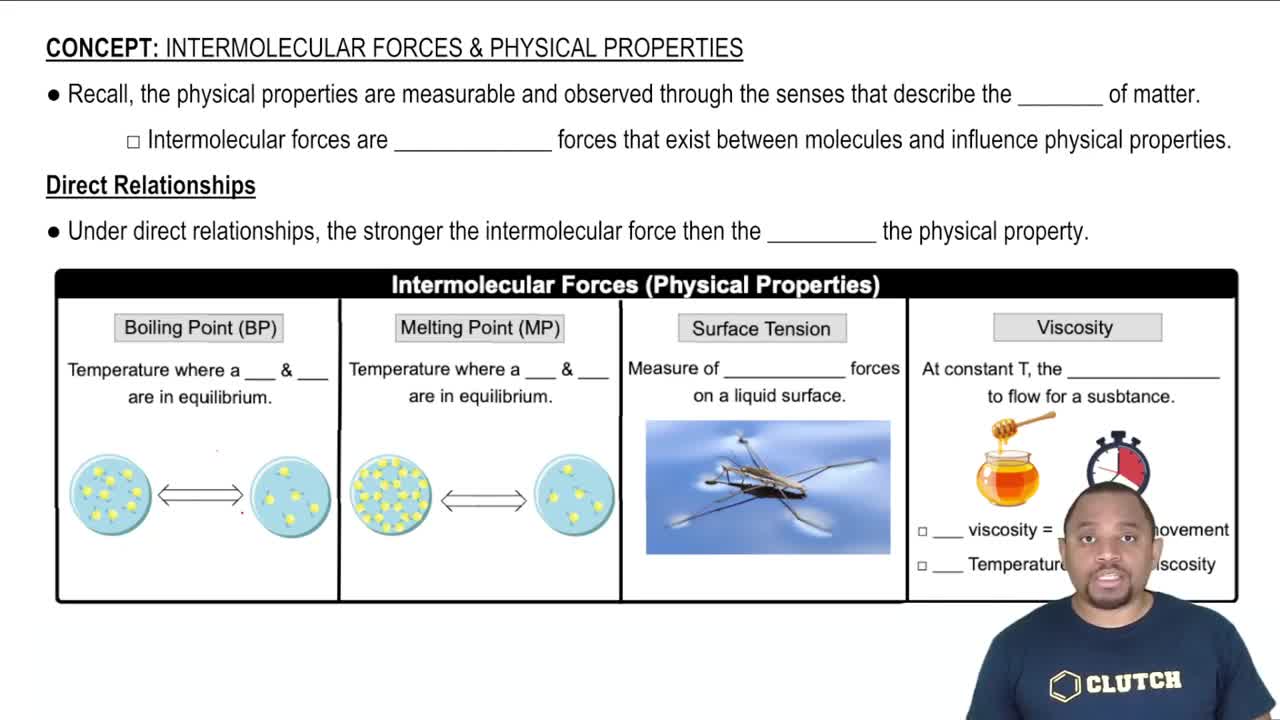
Surface tension is a physical property of liquids that describes the elastic-like force at the surface of a liquid. It arises from the cohesive forces between liquid molecules, which are stronger at the surface due to the lack of neighboring molecules above. This phenomenon explains why water forms droplets on certain surfaces and why it can 'wet' others, depending on the balance between cohesive and adhesive forces.
추천 영상:
가이드 코스
03:13
Intermolecular Forces and Properties

Adhesion and Cohesion

Adhesion refers to the attraction between different substances, while cohesion is the attraction between like molecules. In the case of water, if the adhesive forces between water molecules and a surface are stronger than the cohesive forces among the water molecules, the water will spread out and wet the surface. Conversely, if cohesion dominates, water will bead up, as seen on hydrophobic surfaces.
추천 영상:
가이드 코스
03:13
Intermolecular Forces and Properties

Hydrophobic and Hydrophilic Surfaces

Hydrophobic surfaces repel water and do not allow it to spread, leading to beading, while hydrophilic surfaces attract water, promoting spreading and wetting. The chemical composition and structure of a surface determine its hydrophobicity or hydrophilicity. Mercury, being a dense liquid with strong cohesive forces, beads up on most surfaces due to its high surface tension and lack of adhesive interaction with them.
추천 영상:
가이드 코스
02:31
Photoelectric Effect