Ch.13 - Solids & Modern Materials
Tro - Chemistry: A Molecular Approach 5th Edition
Tro5th EditionChemistry: A Molecular ApproachISBN: 9780134874371당신이 사용하는 게 아니라요?교과서 변경
13장, 문제 60

Which solid would you expect to have the largest band gap? a. As(s) b. Sb(s) c. Bi(s)

검증된 단계별 안내
1
Understand the concept of band gap: The band gap is the energy difference between the valence band and the conduction band in a solid. A larger band gap means the material is more of an insulator, while a smaller band gap indicates a semiconductor or conductor.
Consider the position of elements in the periodic table: Arsenic (As), Antimony (Sb), and Bismuth (Bi) are in the same group (Group 15) and are arranged in order of increasing atomic number.
Recognize the trend in band gap across the periodic table: Generally, as you move down a group in the periodic table, the band gap tends to decrease because the atomic size increases, leading to more overlap of atomic orbitals and thus a smaller energy gap.
Apply the trend to the given elements: Since As, Sb, and Bi are in the same group, the band gap is expected to decrease from As to Bi.
Conclude which element has the largest band gap: Based on the trend, As(s) is expected to have the largest band gap among the three elements.

비슷한 문제에 대한 검증된 영상 답변:

이 영상 해법은 위 문제에 도움이 된다고 튜터들이 추천한 것입니다.
영상 길이:
2m
도움이 되었나요?

주요 개념

질문에 올바르게 답하기 위해 반드시 이해해야 하는 핵심 개념들은 다음과 같습니다.

Band Gap

The band gap is the energy difference between the valence band and the conduction band in a solid material. It determines the electrical conductivity of the material; a larger band gap typically indicates that the material is an insulator or semiconductor, while a smaller band gap suggests metallic properties. Understanding band gaps is crucial for predicting how materials will behave in electronic and optical applications.
추천 영상:
가이드 코스
03:13
Intepreting the Band of Stability

Semiconductors and Insulators

Semiconductors are materials that have a moderate band gap, allowing them to conduct electricity under certain conditions, such as increased temperature or doping. Insulators, on the other hand, have large band gaps, preventing the flow of electricity under normal conditions. The classification of materials based on their band gaps is essential for applications in electronics, photovoltaics, and optoelectronics.
추천 영상:
가이드 코스
03:37
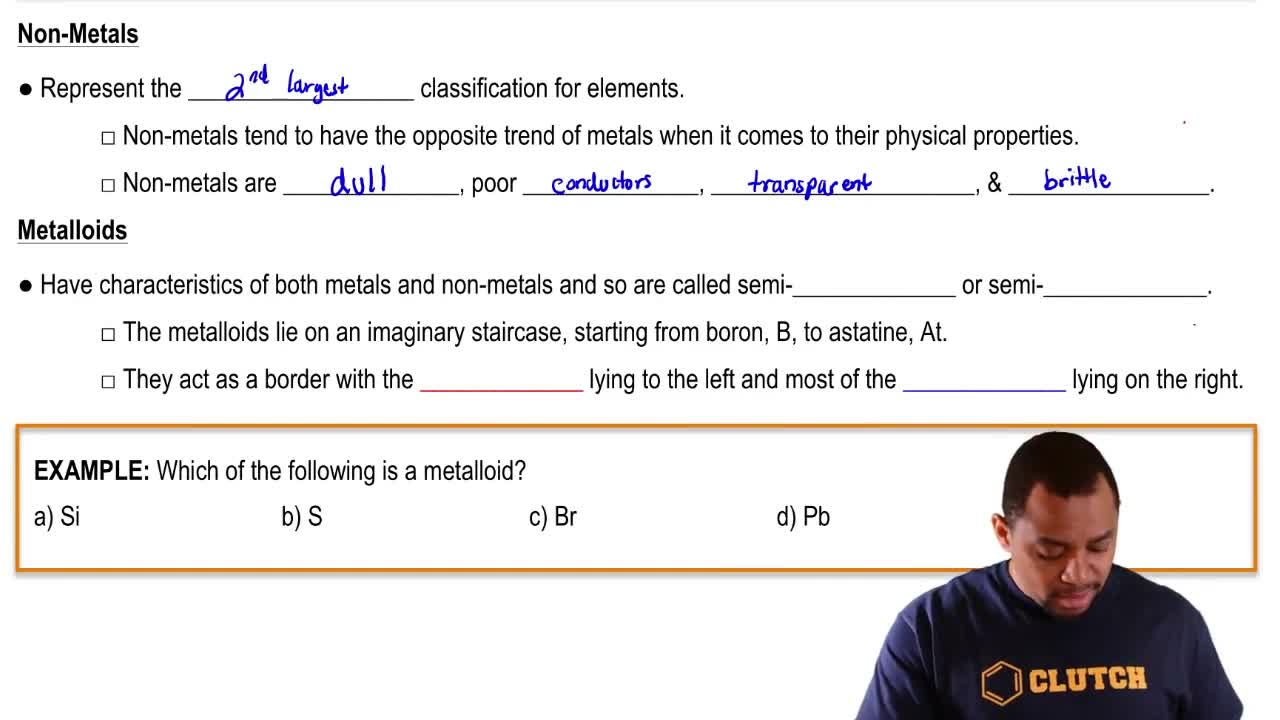
Metalloid Properties

Trends in Group 15 Elements

The elements arsenic (As), antimony (Sb), and bismuth (Bi) belong to Group 15 of the periodic table, which shows trends in properties such as atomic size and electronegativity. As you move down the group, the band gap generally decreases due to increased atomic size and decreased electronegativity, affecting the overlap of atomic orbitals. Recognizing these trends helps in predicting the electronic properties of these elements.
추천 영상:
가이드 코스
00:59
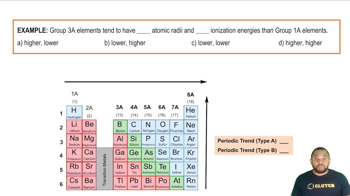
Main Group Elements: Periodic Trends Example