What mass of salt (NaCl) should you add to 1.00 L of water in an ice cream maker to make a solution that freezes at -10.0 °C? Assume complete dissociation of the NaCl and density of 1.00 g/mL for water.
Ch.14 - Solutions
14장, 문제 94
A 0.95 m aqueous solution of an ionic compound with the formula MX has a freezing point of -3.0 °C. Calculate the van’t Hoff factor (i) for MX at this concentration.
검증된 단계별 안내1
insert step 1> Determine the freezing point depression (\( \Delta T_f \)) using the formula \( \Delta T_f = T_f^0 - T_f \), where \( T_f^0 \) is the freezing point of pure water (0 °C) and \( T_f \) is the freezing point of the solution (-3.0 °C).
insert step 2> Use the formula for freezing point depression: \( \Delta T_f = i \cdot K_f \cdot m \), where \( K_f \) is the cryoscopic constant for water (1.86 °C/m) and \( m \) is the molality of the solution (0.95 m).
insert step 3> Rearrange the formula to solve for the van’t Hoff factor \( i \): \( i = \frac{\Delta T_f}{K_f \cdot m} \).
insert step 4> Substitute the known values into the equation: \( i = \frac{3.0}{1.86 \times 0.95} \).
insert step 5> Calculate the value of \( i \) to determine the van’t Hoff factor for the ionic compound MX.
주요 개념
질문에 올바르게 답하기 위해 반드시 이해해야 하는 핵심 개념들은 다음과 같습니다.
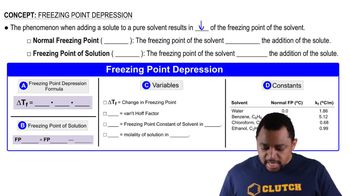
Freezing Point Depression
Freezing point depression is a colligative property that describes how the freezing point of a solvent decreases when a solute is added. The extent of this depression is directly proportional to the number of solute particles in the solution. The formula used to calculate the change in freezing point is ΔTf = i * Kf * m, where ΔTf is the change in freezing point, Kf is the freezing point depression constant, and m is the molality of the solution.
추천 영상:
가이드 코스
Freezing Point Depression
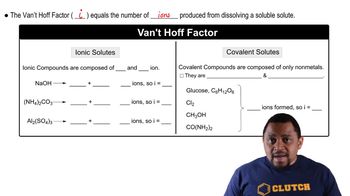
Van't Hoff Factor (i)
The van't Hoff factor (i) represents the number of particles into which a solute dissociates in solution. For ionic compounds, this factor is crucial as it affects colligative properties like freezing point depression and boiling point elevation. For example, if an ionic compound MX dissociates into M⁺ and X⁻, the van't Hoff factor would be 2, indicating that two particles are produced per formula unit of the solute.
추천 영상:
가이드 코스
Van't Hoff Factor
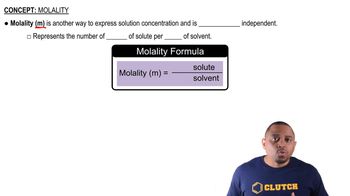
Molality (m)
Molality (m) is a measure of concentration defined as the number of moles of solute per kilogram of solvent. It is particularly useful in colligative property calculations because it remains unaffected by temperature changes, unlike molarity. In the context of freezing point depression, knowing the molality of the solution allows for accurate calculations of how much the freezing point will decrease based on the number of solute particles present.
추천 영상:
가이드 코스
Molality
관련 실천
교과서 질문
2756
views
교과서 질문
Use the van't Hoff factors in Table 13.9 to calculate each colligative property: a. the melting point of a 0.100 m iron(III) chloride solution
1654
views
1
rank
교과서 질문
A 0.100 M ionic solution has an osmotic pressure of 8.3 atm at 25 °C. Calculate the van't Hoff factor (i) for this solution.
1871
views
교과서 질문
A 1.2 m aqueous solution of an ionic compound with the formula MX2 has a boiling point of 101.4 °C. Calculate the van't Hoff factor (i) for MX2 at this concentration.
1529
views
교과서 질문
Calculate the vapor pressure at 25 °C of an aqueous solution that is 5.50% NaCl by mass. (Assume complete dissociation of the solute.)
2287
views