Ch.14 - Solutions
Tro - Chemistry: A Molecular Approach 5th Edition
Tro5th EditionChemistry: A Molecular ApproachISBN: 9780134874371당신이 사용하는 게 아니라요?교과서 변경
14장, 문제 81

Calculate the molar mass of an unknown compound given that an aqueous solution containing 17.5 g of the compound in 100.0 g of water has a freezing point of -1.8 °C.

검증된 단계별 안내
1
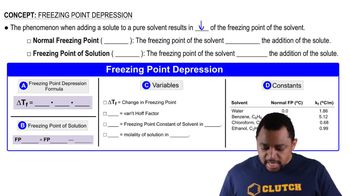
Step 1: Understand the concept of freezing point depression. The freezing point of a solution is lower than that of the pure solvent. The change in freezing point (\( \Delta T_f \)) is related to the molality (\( m \)) of the solution and the freezing point depression constant (\( K_f \)) of the solvent.
Step 2: Use the formula for freezing point depression: \( \Delta T_f = i \cdot K_f \cdot m \), where \( i \) is the van't Hoff factor (assumed to be 1 for non-electrolytes), \( K_f \) is the freezing point depression constant for water (1.86 °C kg/mol), and \( m \) is the molality of the solution.
Step 3: Calculate the change in freezing point: \( \Delta T_f = 0 - (-1.8) = 1.8 \) °C.
Step 4: Rearrange the formula to solve for molality: \( m = \frac{\Delta T_f}{i \cdot K_f} = \frac{1.8}{1 \cdot 1.86} \) mol/kg.
Step 5: Use the definition of molality (moles of solute per kilogram of solvent) to find the molar mass of the compound. Calculate the moles of solute using the molality and the mass of the solvent (0.1 kg), then use the mass of the solute (17.5 g) to find the molar mass: \( \text{Molar mass} = \frac{\text{mass of solute}}{\text{moles of solute}} \).

주요 개념

질문에 올바르게 답하기 위해 반드시 이해해야 하는 핵심 개념들은 다음과 같습니다.

Freezing Point Depression

Freezing point depression is a colligative property that describes how the freezing point of a solvent decreases when a solute is added. The extent of this depression is directly proportional to the number of solute particles in the solution. The formula used to calculate the change in freezing point is ΔTf = i * Kf * m, where i is the van 't Hoff factor, Kf is the freezing point depression constant of the solvent, and m is the molality of the solution.
추천 영상:
가이드 코스
01:59
Freezing Point Depression

Molality

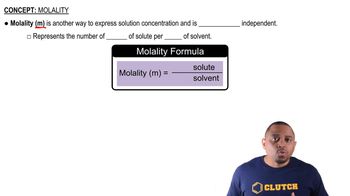
Molality (m) is a measure of concentration defined as the number of moles of solute per kilogram of solvent. It is particularly useful in colligative property calculations because it directly relates to the number of solute particles in a given mass of solvent. To calculate molality, you can use the formula m = moles of solute / mass of solvent (in kg).
추천 영상:

Molar Mass

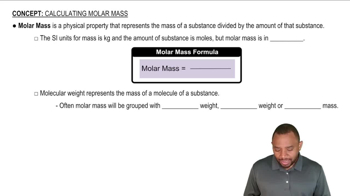
Molar mass is the mass of one mole of a substance, typically expressed in grams per mole (g/mol). It can be calculated by dividing the mass of the substance by the number of moles present. In the context of the question, determining the molar mass of the unknown compound involves using the freezing point depression data to find the number of moles of solute, which can then be used to calculate the molar mass.
추천 영상:
가이드 코스
02:11
Molar Mass Concept