Ch.15 - Chemical Kinetics
Tro - Chemistry: A Molecular Approach 5th Edition
Tro5th EditionChemistry: A Molecular ApproachISBN: 9780134874371당신이 사용하는 게 아니라요?교과서 변경
15장, 문제 96

Is the overall reaction exothermic or endothermic in the mechanism where HCl adds across the double bond of ethene to form H3C¬CH2Cl, with the energy diagram indicating step 1 as HCl + H2C“CH2 → H3C“CH2+ + Cl⁻ and step 2 as H3C“CH2+ + Cl⁻ → H3C¬CH2Cl?

검증된 단계별 안내
1
insert step 1> Identify the type of reaction: The reaction involves the addition of HCl across the double bond of ethene, which is a typical electrophilic addition reaction.
insert step 2> Analyze the energy diagram: Look at the energy levels of the reactants, intermediates, and products. The energy diagram will show whether the overall energy of the products is lower or higher than the reactants.
insert step 3> Determine the energy change for each step: Step 1 involves the formation of a carbocation intermediate (H3C-CH2+), and Step 2 involves the combination of this carbocation with Cl⁻ to form the final product (H3C-CH2Cl).
insert step 4> Assess the energy of the intermediate: The formation of a carbocation is typically endothermic, as it requires energy to break the π bond and form the carbocation.
insert step 5> Evaluate the overall energy change: Compare the energy of the final product (H3C-CH2Cl) with the initial reactants (HCl + H2C=CH2). If the energy of the products is lower, the reaction is exothermic; if higher, it is endothermic.

주요 개념

질문에 올바르게 답하기 위해 반드시 이해해야 하는 핵심 개념들은 다음과 같습니다.

Exothermic and Endothermic Reactions

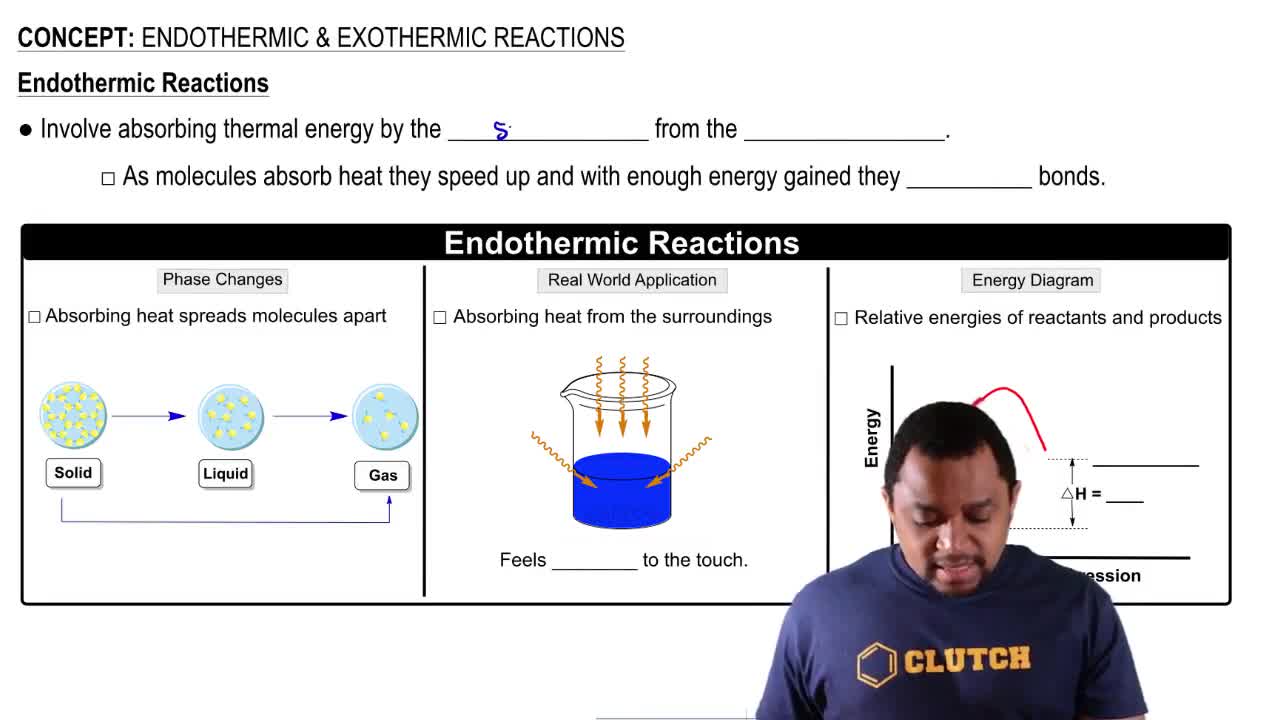
Exothermic reactions release energy, usually in the form of heat, to the surroundings, resulting in a temperature increase. In contrast, endothermic reactions absorb energy, leading to a temperature decrease. The classification of a reaction as exothermic or endothermic depends on the overall energy change from reactants to products.
추천 영상:
가이드 코스
02:30
Endothermic & Exothermic Reactions

Energy Diagrams

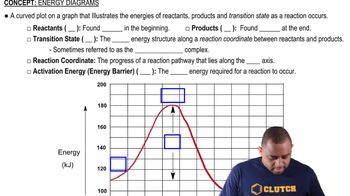
Energy diagrams visually represent the energy changes during a chemical reaction. They typically show the energy of reactants and products, as well as the activation energy required for the reaction to proceed. The shape of the diagram helps determine whether the reaction is exothermic or endothermic based on the relative energy levels of the reactants and products.
추천 영상:
가이드 코스
01:57
Energy Diagrams

Reaction Mechanism

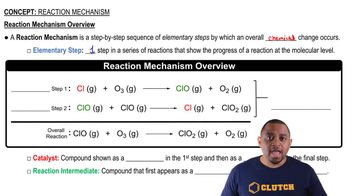
A reaction mechanism outlines the step-by-step sequence of elementary reactions that occur during a chemical transformation. Each step may involve the formation of intermediates and transition states, which can influence the overall energy change of the reaction. Understanding the mechanism is crucial for determining the energy profile and whether the overall reaction is exothermic or endothermic.
추천 영상:
가이드 코스
03:06
Reaction Mechanism Overview