Ch.15 - Chemical Kinetics
Tro - Chemistry: A Molecular Approach 5th Edition
Tro5th EditionChemistry: A Molecular ApproachISBN: 9780134874371당신이 사용하는 게 아니라요?교과서 변경
15장, 문제 81

Suppose that a catalyst lowers the activation barrier of a reaction from 125 kJ/mol to 55 kJ/mol. By what factor would you expect the reaction rate to increase at 25 °C? (Assume that the frequency factors for the catalyzed and uncatalyzed reactions are identical.)

검증된 단계별 안내
1
Identify the Arrhenius equation: \(k = A e^{-\frac{E_a}{RT}}\), where \(k\) is the rate constant, \(A\) is the frequency factor, \(E_a\) is the activation energy, \(R\) is the gas constant (8.314 J/mol·K), and \(T\) is the temperature in Kelvin.
Convert the temperature from Celsius to Kelvin: \(T = 25 + 273.15 = 298.15\) K.
Calculate the rate constant for the uncatalyzed reaction using the activation energy \(E_{a1} = 125\) kJ/mol. Convert \(E_{a1}\) to J/mol: \(E_{a1} = 125,000\) J/mol.
Calculate the rate constant for the catalyzed reaction using the activation energy \(E_{a2} = 55\) kJ/mol. Convert \(E_{a2}\) to J/mol: \(E_{a2} = 55,000\) J/mol.
Determine the factor by which the reaction rate increases by taking the ratio of the rate constants: \(\frac{k_2}{k_1} = \frac{A e^{-\frac{E_{a2}}{RT}}}{A e^{-\frac{E_{a1}}{RT}}} = e^{-\frac{E_{a2} - E_{a1}}{RT}}\).

주요 개념

질문에 올바르게 답하기 위해 반드시 이해해야 하는 핵심 개념들은 다음과 같습니다.

Activation Energy

Activation energy is the minimum energy required for a chemical reaction to occur. It represents the energy barrier that reactants must overcome to form products. Lowering the activation energy, as a catalyst does, increases the number of reactant molecules that can successfully collide and react, thereby increasing the reaction rate.
추천 영상:
가이드 코스
02:02
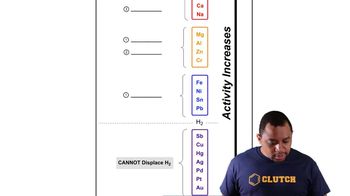
Activity Series Chart

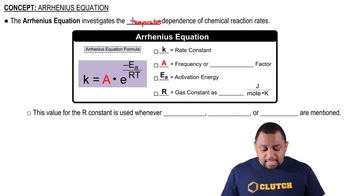
Arrhenius Equation

The Arrhenius equation describes the temperature dependence of reaction rates and is given by k = A * e^(-Ea/RT), where k is the rate constant, A is the frequency factor, Ea is the activation energy, R is the gas constant, and T is the temperature in Kelvin. This equation shows that a decrease in activation energy (Ea) leads to an exponential increase in the rate constant (k), which directly correlates to an increase in reaction rate.
추천 영상:
가이드 코스
01:20
Arrhenius Equation

Catalysis

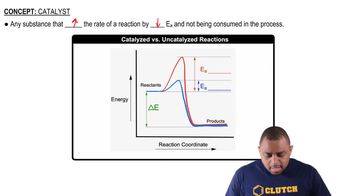
Catalysis is the process of increasing the rate of a chemical reaction by adding a substance called a catalyst, which is not consumed in the reaction. Catalysts work by providing an alternative reaction pathway with a lower activation energy, allowing more reactant molecules to participate in the reaction at a given temperature, thus enhancing the overall reaction rate.
추천 영상:
가이드 코스
01:59
Catalyzed vs. Uncatalyzed Reactions