Ch.15 - Chemical Kinetics
Tro - Chemistry: A Molecular Approach 5th Edition
Tro5th EditionChemistry: A Molecular ApproachISBN: 9780134874371당신이 사용하는 게 아니라요?교과서 변경
15장, 문제 67

The tabulated data were collected for the second-order reaction: Cl(g) + H2(g) → HCl(g) + H(g). Use an Arrhenius plot to determine the activation barrier and frequency factor for the reaction. Temperature (K) and Rate Constant (L/mol # s) are as follows: 90 K, 0.00357; 100 K, 0.0773; 110 K, 0.956; 120 K, 7.781.

검증된 단계별 안내
1
Convert the given temperatures from Kelvin to the reciprocal of temperature in Kelvin (1/T) for each data point.
Take the natural logarithm of the rate constant (k) for each temperature to obtain ln(k).
Plot ln(k) on the y-axis against 1/T on the x-axis to create the Arrhenius plot.
Determine the slope of the line from the Arrhenius plot, which is equal to -Ea/R, where Ea is the activation energy and R is the universal gas constant (8.314 J/mol K).
Calculate the activation energy (Ea) using the slope, and determine the frequency factor (A) by finding the y-intercept of the line, which is equal to ln(A).

주요 개념

질문에 올바르게 답하기 위해 반드시 이해해야 하는 핵심 개념들은 다음과 같습니다.

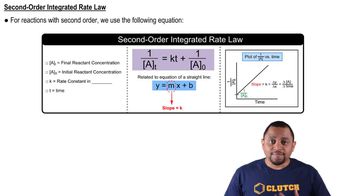
Second-Order Reactions

Second-order reactions are chemical reactions where the rate is proportional to the square of the concentration of one reactant or the product of the concentrations of two reactants. In this case, the reaction between Cl(g) and H2(g) is second-order, meaning that the rate constant (k) will depend on the concentrations of both reactants. Understanding this concept is crucial for analyzing the rate data provided.
추천 영상:
가이드 코스
01:59
Second-Order Reactions

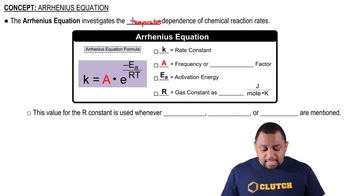
Arrhenius Equation

The Arrhenius equation relates the rate constant of a reaction to the temperature and activation energy. It is expressed as k = A * e^(-Ea/RT), where k is the rate constant, A is the frequency factor, Ea is the activation energy, R is the universal gas constant, and T is the temperature in Kelvin. This equation is fundamental for determining the activation barrier and frequency factor from the provided rate constants at different temperatures.
추천 영상:
가이드 코스
01:20
Arrhenius Equation

Activation Energy

Activation energy (Ea) is the minimum energy required for a chemical reaction to occur. It represents the energy barrier that reactants must overcome to form products. In the context of the Arrhenius plot, a linear relationship between ln(k) and 1/T allows for the determination of Ea from the slope of the line, which is essential for understanding the kinetics of the given reaction.
추천 영상:
가이드 코스
02:02
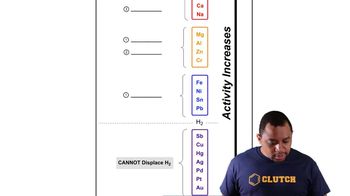
Activity Series Chart