Ch.15 - Chemical Kinetics
Tro - Chemistry: A Molecular Approach 5th Edition
Tro5th EditionChemistry: A Molecular ApproachISBN: 9780134874371당신이 사용하는 게 아니라요?교과서 변경
15장, 문제 54b

This reaction was monitored as a function of time: AB → A + B A plot of 1/[AB] versus time yields a straight line with a slope of +0.55/Ms. b. Write the rate law for the reaction.

검증된 단계별 안내
1
Identify the order of the reaction by analyzing the plot. A straight line in a plot of 1/[AB] versus time indicates a second-order reaction.
For a second-order reaction, the rate law is expressed as: rate = k[AB]^2.
The slope of the line in the plot of 1/[AB] versus time is equal to the rate constant k for a second-order reaction.
Given that the slope is +0.55/Ms, this value represents the rate constant k.
Therefore, the rate law for the reaction is: rate = 0.55 [AB]^2.

비슷한 문제에 대한 검증된 영상 답변:

이 영상 해법은 위 문제에 도움이 된다고 튜터들이 추천한 것입니다.
영상 길이:
3m
도움이 되었나요?

주요 개념

질문에 올바르게 답하기 위해 반드시 이해해야 하는 핵심 개념들은 다음과 같습니다.

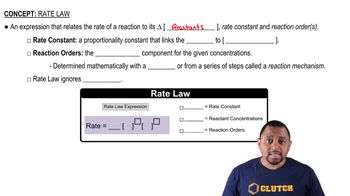
Rate Law

The rate law of a chemical reaction expresses the relationship between the rate of the reaction and the concentration of its reactants. It is typically formulated as rate = k[A]^m[B]^n, where k is the rate constant, and m and n are the orders of the reaction with respect to reactants A and B. Understanding the rate law is essential for predicting how changes in concentration affect the reaction rate.
추천 영상:
가이드 코스
01:52
Rate Law Fundamentals

Order of Reaction

The order of a reaction refers to the power to which the concentration of a reactant is raised in the rate law. It indicates how the rate of reaction is affected by the concentration of that reactant. In this case, since the plot of 1/[AB] versus time is linear, it suggests that the reaction is second-order with respect to AB, meaning the rate is proportional to the square of the concentration of AB.
추천 영상:
가이드 코스
00:36
Average Bond Order

Integrated Rate Laws

Integrated rate laws relate the concentration of reactants to time and are derived from the differential rate laws. For a second-order reaction, the integrated rate law is given by 1/[AB] = kt + 1/[AB]0, where [AB]0 is the initial concentration. The linear relationship observed in the plot indicates that the reaction follows this integrated form, allowing us to determine the rate constant from the slope.
추천 영상:
가이드 코스
01:52
Rate Law Fundamentals