Ch.16 - Chemical Equilibrium
Tro - Chemistry: A Molecular Approach 5th Edition
Tro5th EditionChemistry: A Molecular ApproachISBN: 9780134874371당신이 사용하는 게 아니라요?교과서 변경
16장, 문제 66a

Consider this reaction at equilibrium: C(s) + H2O(g) ⇌ CO(g) + H2(g) Predict whether the reaction will shift left, shift right, or remain unchanged after each disturbance. a. C is added to the reaction mixture. b. H2O is condensed and removed from the reaction mixture. Predict whether the reaction will shift left, shift right, or remain unchanged after each disturbance. c. CO is added to the reaction mixture. d. H2 is removed from the reaction mixture.

검증된 단계별 안내
1
Identify the reaction and the disturbance: The reaction given is C(s) + H2O(g) ⇌ CO(g) + H2(g), and the disturbance is the addition of solid carbon (C).
Understand the role of solid carbon in the reaction: Solid carbon (C) is a reactant in the given equilibrium reaction.
Apply Le Chatelier's Principle: According to Le Chatelier's Principle, if a reactant or product is added to a system at equilibrium, the system will shift in a direction that will use up the added substance.
Analyze the effect of adding more carbon: Adding more carbon (C) increases the concentration of one of the reactants.
Predict the direction of the shift: Since more reactant (C) is added, the reaction will shift to the right to form more products (CO and H2) and use up the added carbon.

비슷한 문제에 대한 검증된 영상 답변:

이 영상 해법은 위 문제에 도움이 된다고 튜터들이 추천한 것입니다.
영상 길이:
1m
도움이 되었나요?

주요 개념

질문에 올바르게 답하기 위해 반드시 이해해야 하는 핵심 개념들은 다음과 같습니다.

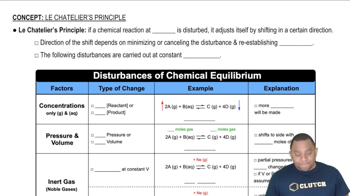
Le Chatelier's Principle

Le Chatelier's Principle states that if a dynamic equilibrium is disturbed by changing the conditions, the system will adjust to counteract the change and restore a new equilibrium. This principle helps predict the direction of the shift in equilibrium when a change is applied, such as concentration, pressure, or temperature.
추천 영상:
가이드 코스
07:32
Le Chatelier's Principle

Equilibrium Constant (K)

The equilibrium constant (K) is a numerical value that expresses the ratio of the concentrations of products to reactants at equilibrium for a given reaction at a specific temperature. It provides insight into the position of equilibrium; a larger K indicates a greater concentration of products, while a smaller K suggests a higher concentration of reactants.
추천 영상:
가이드 코스
01:14
Equilibrium Constant K

Effect of Concentration Changes

When the concentration of a reactant or product in a chemical reaction at equilibrium is changed, the system will respond by shifting the equilibrium position to either the left (toward reactants) or the right (toward products). In this case, adding more solid carbon (C) does not affect the equilibrium position since solids do not appear in the equilibrium expression, thus the reaction remains unchanged.
추천 영상:
가이드 코스
02:31
Photoelectric Effect
관련 실천
교과서 질문

Consider this reaction at equilibrium: 2 BrNO(g) ⇌ 2 NO(g) + Br2(g) Predict whether the reaction will shift left, shift right, or remain unchanged after each disturbance. b. BrNO is added to the reaction mixture.

773
views

교과서 질문

Each reaction is allowed to come to equilibrium, and then the volume is changed as indicated. Predict the effect (shift right, shift left, or no effect) of the indicated volume change. a. I2( g) ⇌ 2 I( g) (volume is increased) b. 2 H2S( g) ⇌ 2 H2( g) + S2(g) (volume is decreased) c. I2(g) + Cl2(g) ⇌ 2 ICl(g) (volume is decreased)

1210
views
교과서 질문

Each reaction is allowed to come to equilibrium, and then the volume is changed as indicated. Predict the effect (shift right, shift left, or no effect) of the indicated volume change. a. CO(g) + H2O( g) ⇌ CO2(g) + H2(g) (volume is decreased)

456
views
교과서 질문

Consider this reaction at equilibrium: 2 BrNO(g) ⇌ 2 NO(g) + Br2(g) Predict whether the reaction will shift left, shift right, or remain unchanged after each disturbance. a. NO is added to the reaction mixture.

815
views
교과서 질문

Consider this reaction at equilibrium: 2 BrNO(g) ⇌ 2 NO(g) + Br2(g) Predict whether the reaction will shift left, shift right, or remain unchanged after each disturbance. c. Br2 is removed from the reaction mixture.

1924
views
교과서 질문

Each reaction is allowed to come to equilibrium, and then the volume is changed as indicated. Predict the effect (shift right, shift left, or no effect) of the indicated volume change. b. PCl3(g) + Cl2(g) ⇌ PCl5(g) (volume is increased)

373
views