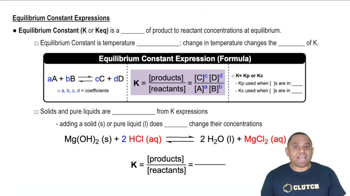
Consider the reaction: N2(g) + 3 H2(g) ⇌ 2 NH3(g) Complete the table. Assume that all concentrations are equilibrium concentrations in M.
T (K) [N2] [H2] [NH3] Kc
500 0.115 0.105 0.439 _
575 0.110 _ 0.128 9.6
775 0.120 0.140 _ 0.0584
검증된 단계별 안내Consider the reaction: N2(g) + 3 H2(g) ⇌ 2 NH3(g) Complete the table. Assume that all concentrations are equilibrium concentrations in M.
T (K) [N2] [H2] [NH3] Kc
500 0.115 0.105 0.439 _
575 0.110 _ 0.128 9.6
775 0.120 0.140 _ 0.0584
Consider the following reaction: H2(g) + I2(g) ⇌ 2 HI(g) Complete the table. Assume that all concentrations are equilibrium concentrations in M.
T (°C) [H2] [I2] [HI] Kc
25 0.0355 0.0388 0.922 _
340 _ 0.0455 0.387 9.6
445 0.0485 0.0468 _ 50.2
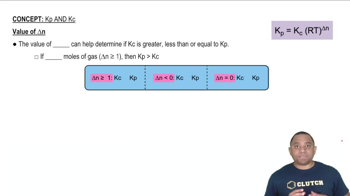
Calculate Kp for each reaction.
b. N2(g) + 3 H2(g) ⇌ 2 NH3(g) Kc = 3.7⨉108 (at 298 K)
c. N2(g) + O2(g) ⇌ 2 NO(g) Kc = 4.10⨉10-31 (at 298 K)
Consider the reaction: 2 NO(g) + Br2(g) ⇌ 2 NOBr(g) Kp = 28.4 at 298K In a reaction mixture at equilibrium, the partial pressure of NO is 108 torr and that of Br2 is 126 torr. What is the partial pressure of NOBr in this mixture?
Calculate Kp for each reaction. a. N2O4(g) ⇌ 2 NO2(g) Kc = 5.9⨉10-3 (at 298 K)