Ch.17 - Acids and Bases
Tro - Chemistry: A Molecular Approach 5th Edition
Tro5th EditionChemistry: A Molecular ApproachISBN: 9780134874371당신이 사용하는 게 아니라요?교과서 변경
17장, 문제 99b

Determine whether each cation is acidic or pH-neutral. For those cations that are acidic, write an equation that shows how the cation acts as an acid. b. Na+

검증된 단계별 안내
1
Identify the cation in question: Na^+.
Recall that Na^+ is the cation of a strong base, NaOH.
Understand that cations from strong bases, like Na^+, are typically pH-neutral because they do not react with water to form H^+ ions.
Conclude that Na^+ is pH-neutral and does not act as an acid in water.
No equation is needed since Na^+ does not act as an acid.

비슷한 문제에 대한 검증된 영상 답변:

이 영상 해법은 위 문제에 도움이 된다고 튜터들이 추천한 것입니다.
영상 길이:
41s
도움이 되었나요?

주요 개념

질문에 올바르게 답하기 위해 반드시 이해해야 하는 핵심 개념들은 다음과 같습니다.

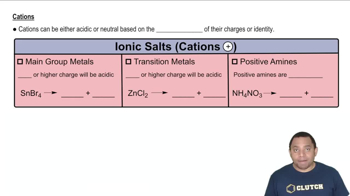
Acidic Cations

Acidic cations are positively charged ions that can donate protons (H+) in solution, thereby lowering the pH. These cations typically arise from weak bases or metal ions that can hydrolyze in water, forming acidic solutions. Understanding the nature of the cation and its ability to interact with water is crucial for determining its acidity.
추천 영상:
가이드 코스
02:26
Cation Acidity in Salts

pH-Neutral Cations

pH-neutral cations do not significantly affect the pH of a solution. They are usually derived from strong bases and do not hydrolyze in water to produce H+ ions. Sodium ion (Na+) is a prime example, as it comes from the strong base sodium hydroxide (NaOH) and remains neutral in solution.
추천 영상:

Hydrolysis Reactions

Hydrolysis reactions involve the reaction of a cation with water, leading to the formation of an acid or a base. In the case of acidic cations, this reaction results in the release of H+ ions, which can be represented by an equation. Understanding hydrolysis is essential for predicting the behavior of cations in aqueous solutions.
추천 영상:
가이드 코스
01:30
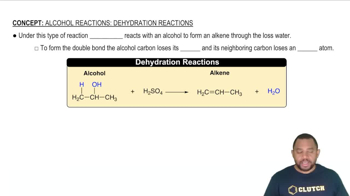
Alcohol Reactions: Dehydration Reactions