Ch.17 - Acids and Bases
Tro - Chemistry: A Molecular Approach 5th Edition
Tro5th EditionChemistry: A Molecular ApproachISBN: 9780134874371당신이 사용하는 게 아니라요?교과서 변경
17장, 문제 141

Write net ionic equations for the reactions that take place when aqueous solutions of the following substances are mixed: a. sodium cyanide and nitric acid b. ammonium chloride and sodium hydroxide c. sodium cyanide and ammonium bromide d. potassium hydrogen sulfate and lithium acetate e. sodium hypochlorite and ammonia

검증된 단계별 안내
1
Identify the chemical formulas of the reactants: sodium cyanide (NaCN) and nitric acid (HNO₃).
Write the balanced molecular equation for the reaction: NaCN(aq) + HNO₃(aq) → NaNO₃(aq) + HCN(g).
Determine the states of matter for each compound: NaCN and HNO₃ are aqueous, NaNO₃ is aqueous, and HCN is a gas.
Write the complete ionic equation by dissociating all strong electrolytes into their ions: Na⁺(aq) + CN⁻(aq) + H⁺(aq) + NO₃⁻(aq) → Na⁺(aq) + NO₃⁻(aq) + HCN(g).
Cancel out the spectator ions (Na⁺ and NO₃⁻) to write the net ionic equation: CN⁻(aq) + H⁺(aq) → HCN(g).

비슷한 문제에 대한 검증된 영상 답변:

이 영상 해법은 위 문제에 도움이 된다고 튜터들이 추천한 것입니다.
영상 길이:
3m
도움이 되었나요?

주요 개념

질문에 올바르게 답하기 위해 반드시 이해해야 하는 핵심 개념들은 다음과 같습니다.

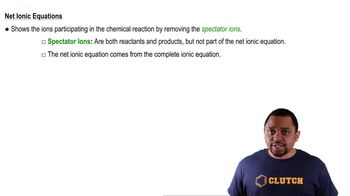
Net Ionic Equations

Net ionic equations represent the actual chemical species that participate in a reaction, excluding spectator ions. They are derived from complete ionic equations by removing ions that do not change during the reaction. This simplification helps to focus on the essential chemical changes occurring in the solution.
추천 영상:
가이드 코스
00:51
Net Ionic Equations

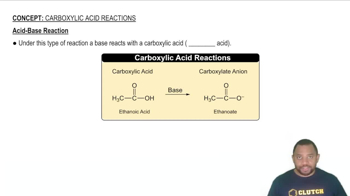
Acid-Base Reactions

Acid-base reactions involve the transfer of protons (H+) between reactants. In this context, nitric acid (a strong acid) donates protons, while sodium cyanide can act as a weak base. Understanding the behavior of acids and bases is crucial for predicting the products of their reactions.
추천 영상:
가이드 코스
01:09
Acid-Base Reaction

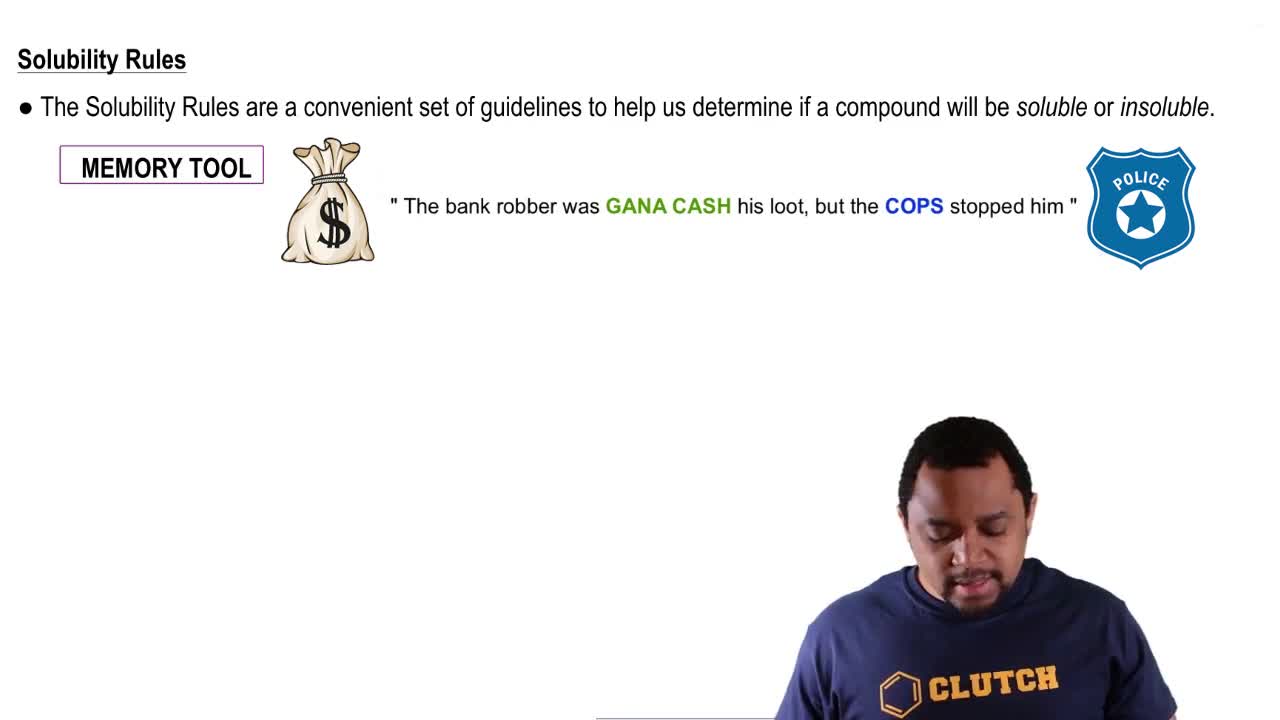
Solubility Rules

Solubility rules help predict whether a compound will dissolve in water or form a precipitate. For example, sodium salts are generally soluble, while certain metal cyanides may not be. Knowing these rules is essential for determining the species present in solution and writing accurate net ionic equations.
추천 영상:
가이드 코스
00:28
Solubility Rules