Ch.18 - Aqueous Ionic Equilibrium
Tro - Chemistry: A Molecular Approach 5th Edition
Tro5th EditionChemistry: A Molecular ApproachISBN: 9780134874371당신이 사용하는 게 아니라요?교과서 변경
18장, 문제 35

A buffer contains significant amounts of acetic acid and sodium acetate. Write equations showing how this buffer neutralizes added acid and added base.

검증된 단계별 안내
1
Identify the components of the buffer system: Acetic acid (CH3COOH) is a weak acid and sodium acetate (CH3COONa) is its conjugate base. Together, they form a buffer system.
Write the chemical equation for the reaction of acetic acid with added base (OH- ions): CH3COOH + OH- → CH3COO- + H2O. This equation shows how the acetic acid component of the buffer reacts with hydroxide ions to form water and acetate ions, thus neutralizing the added base.
Identify the role of sodium acetate in the buffer: Sodium acetate dissociates in water to give sodium ions (Na+) and acetate ions (CH3COO-). The acetate ion is the conjugate base of acetic acid.
Write the chemical equation for the reaction of acetate ions with added acid (H+ ions): CH3COO- + H+ → CH3COOH. This equation demonstrates how the acetate ions from sodium acetate react with hydrogen ions to form acetic acid, neutralizing the added acid.
Understand the buffer action: The buffer system can neutralize added acid or base through these reactions, maintaining the pH of the solution relatively constant despite the addition of small amounts of strong acid or base.

비슷한 문제에 대한 검증된 영상 답변:

이 영상 해법은 위 문제에 도움이 된다고 튜터들이 추천한 것입니다.
영상 길이:
2m
도움이 되었나요?

주요 개념

질문에 올바르게 답하기 위해 반드시 이해해야 하는 핵심 개념들은 다음과 같습니다.

Buffer Solutions

Buffer solutions are mixtures that resist changes in pH when small amounts of acid or base are added. They typically consist of a weak acid and its conjugate base, or a weak base and its conjugate acid. In this case, acetic acid (a weak acid) and sodium acetate (its conjugate base) form a buffer that can maintain a stable pH.
추천 영상:
가이드 코스
03:02
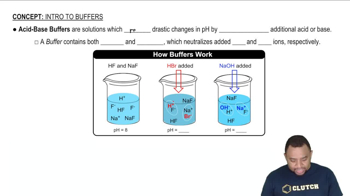
Buffer Solutions

Neutralization Reactions

Neutralization reactions occur when an acid reacts with a base to form water and a salt. In the context of a buffer, when added acid (H⁺ ions) is introduced, it reacts with the conjugate base (acetate ions) to form more acetic acid, thereby minimizing pH changes. Conversely, when a base is added, it reacts with the weak acid to form water and the conjugate base.
추천 영상:
가이드 코스
05:56
Lewis Dot Structures: Neutral Compounds

Equilibrium in Buffer Systems

Buffer systems operate based on the principle of chemical equilibrium, where the concentrations of the weak acid and its conjugate base adjust to counteract changes in pH. The equilibrium can shift in response to added acids or bases, allowing the buffer to maintain a relatively constant pH. This dynamic balance is crucial for the buffer's effectiveness in biological and chemical systems.
추천 영상:
가이드 코스
00:45
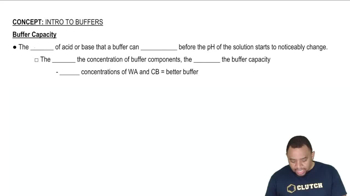
Buffer Capacity