Determine if each compound is more soluble in acidic solution than it is in pure water. Explain. a. BaCO3 b. CuS c. AgCl d. PbI2
Ch.18 - Aqueous Ionic Equilibrium
18장, 문제 97c
Calculate the molar solubility of calcium hydroxide in a solution buffered at each pH. c. pH = 9
검증된 단계별 안내1
insert step 1> Calculate the concentration of hydroxide ions, [OH^-], in the solution using the pH value. Since pH + pOH = 14, find pOH by subtracting the given pH from 14. Then, calculate [OH^-] using the formula [OH^-] = 10^{-pOH}.
insert step 2> Write the balanced chemical equation for the dissolution of calcium hydroxide, Ca(OH)_2, in water: Ca(OH)_2 (s) \(\rightleftharpoons\) Ca^{2+} (aq) + 2OH^- (aq).
insert step 3> Write the expression for the solubility product constant, K_{sp}, of calcium hydroxide: K_{sp} = [Ca^{2+}][OH^-]^2.
insert step 4> Assume the molar solubility of Ca(OH)_2 is 's'. Then, [Ca^{2+}] = s and [OH^-] = 2s from the dissolution equation. However, since the solution is buffered, [OH^-] is already known from step 1.
insert step 5> Substitute the known [OH^-] concentration from step 1 and the expression for [Ca^{2+}] into the K_{sp} expression. Solve for 's', the molar solubility of Ca(OH)_2.

비슷한 문제에 대한 검증된 영상 답변:
이 영상 해법은 위 문제에 도움이 된다고 튜터들이 추천한 것입니다.
영상 길이:
7m도움이 되었나요?
주요 개념
질문에 올바르게 답하기 위해 반드시 이해해야 하는 핵심 개념들은 다음과 같습니다.
Molar Solubility
Molar solubility refers to the maximum amount of a solute that can dissolve in a given volume of solvent at a specific temperature, expressed in moles per liter (M). For calcium hydroxide (Ca(OH)2), this involves determining how much of the compound can dissolve in water to reach equilibrium, which is influenced by the pH of the solution.
추천 영상:
가이드 코스
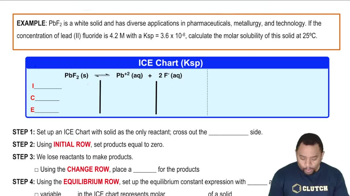
Molar Solubility Example
pH and its Relationship to Solubility
pH is a measure of the acidity or basicity of a solution, with lower values indicating acidic conditions and higher values indicating basic conditions. In the case of calcium hydroxide, which is a strong base, an increase in pH (more basic) can enhance its solubility due to the common ion effect, where the presence of hydroxide ions shifts the dissolution equilibrium.
추천 영상:
가이드 코스
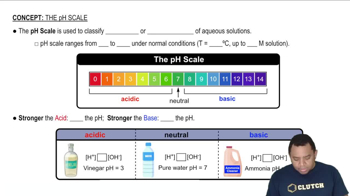
The pH Scale
Equilibrium and the Solubility Product Constant (Ksp)
The solubility product constant (Ksp) is an equilibrium constant that applies to the dissolution of sparingly soluble salts. For calcium hydroxide, Ksp can be expressed in terms of the concentrations of calcium ions and hydroxide ions in solution. Understanding Ksp is crucial for calculating molar solubility, especially when pH affects the concentration of hydroxide ions in the solution.
추천 영상:
가이드 코스
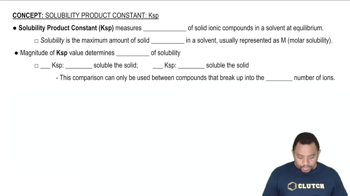
Solubility Product Constant
관련 실천
교과서 질문
3384
views
교과서 질문
A solution containing sodium fluoride is mixed with one containing calcium nitrate to form a solution that is 0.015 M in NaF and 0.010 M in Ca(NO3)2. Does a precipitate form in the mixed solution? If so, identify the precipitate.
1712
views
교과서 질문
Calculate the molar solubility of calcium hydroxide in a solution buffered at each pH. a. pH = 4
2628
views
교과서 질문
Calculate the solubility (in grams per 1.00⨉102 mL of solution) of magnesium hydroxide in a solution buffered at pH = 10. How does this compare to the solubility of Mg(OH)2 in pure water?
1881
views
1
comments
교과서 질문
Calculate the molar solubility of calcium hydroxide in a solution buffered at each pH. b. pH = 7
502
views
교과서 질문
Calculate the molar solubility of MX (Ksp = 1.27⨉10-36) in each liquid or solution. c. 0.20 M Na2X
2231
views