Determine whether or not the mixing of each pair of solutions results in a buffer. a. 75.0 mL of 0.10 M HF; 55.0 mL of 0.15 M NaF b. 150.0 mL of 0.10 M HF; 135.0 mL of 0.175 M HCl d. 125.0 mL of 0.15 M CH3NH2; 120.0 mL of 0.25 M CH3NH3Cl
Ch.18 - Aqueous Ionic Equilibrium
18장, 문제 53d
Determine whether or not the mixing of each pair of solutions results in a buffer. d. 175.0 mL of 0.10 M NH3; 150.0 mL of 0.12 M NaOH
검증된 단계별 안내1
Identify the components needed for a buffer solution: a weak acid and its conjugate base, or a weak base and its conjugate acid.
Recognize that NH3 (ammonia) is a weak base and NaOH (sodium hydroxide) is a strong base.
Understand that a buffer solution requires a weak base and its conjugate acid, not a strong base.
Calculate the moles of NH3: \( \text{moles of NH3} = 0.175 \text{ L} \times 0.10 \text{ M} \).
Calculate the moles of NaOH: \( \text{moles of NaOH} = 0.150 \text{ L} \times 0.12 \text{ M} \).

비슷한 문제에 대한 검증된 영상 답변:
이 영상 해법은 위 문제에 도움이 된다고 튜터들이 추천한 것입니다.
영상 길이:
6m도움이 되었나요?
주요 개념
질문에 올바르게 답하기 위해 반드시 이해해야 하는 핵심 개념들은 다음과 같습니다.
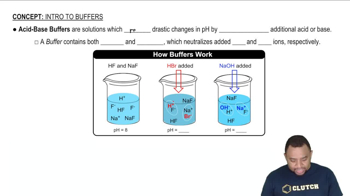
Buffer Solutions
A buffer solution is a system that resists changes in pH upon the addition of small amounts of acid or base. It typically consists of a weak acid and its conjugate base or a weak base and its conjugate acid. Buffers are crucial in maintaining stable pH levels in various chemical and biological processes.
추천 영상:
가이드 코스
Buffer Solutions
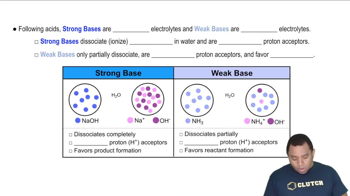
Weak Bases and Strong Bases
Weak bases, like ammonia (NH3), partially ionize in solution, establishing an equilibrium between the base and its conjugate acid (NH4+). In contrast, strong bases, such as sodium hydroxide (NaOH), fully dissociate in solution, leading to a significant increase in hydroxide ions (OH-). Understanding the behavior of these bases is essential for determining buffer capacity.
추천 영상:
가이드 코스
Strong vs Weak Bases
Concentration and Volume in Solution Chemistry
The concentration of a solution, expressed in molarity (M), indicates the amount of solute per liter of solution. When mixing solutions, the total volume and the concentrations of the individual components must be considered to determine the final concentrations of the resulting mixture. This is important for assessing whether the mixture can act as a buffer.
추천 영상:
가이드 코스
Constant-Volume Calorimetry
관련 실천
교과서 질문
2588
views
1
rank
교과서 질문
Determine whether or not the mixing of each pair of solutions results in a buffer. b. 50.0 mL of 0.10 M HCl; 35.0 mL of 0.150 M NaOH
472
views
교과서 질문
Determine whether or not the mixing of each pair of solutions results in a buffer. c. 165.0 mL of 0.10 M HF; 135.0 mL of 0.050 M KOH
487
views
교과서 질문
Determine whether or not the mixing of each pair of solutions results in a buffer. a. 100.0 mL of 0.10 M NH3; 100.0 mL of 0.15 M NH4Cl
637
views
교과서 질문
Determine whether or not the mixing of each pair of solutions results in a buffer. e. 125.0 mL of 0.15 M NH3; 150.0 mL of 0.20 M NaOH
528
views
교과서 질문
Determine whether or not the mixing of each pair of solutions results in a buffer. c. 50.0 mL of 0.15 M HF; 20.0 mL of 0.15 M NaOH
393
views
